


By CA Anil K Jain
Water scarcity in India is no longer a distant warning. It has become one of the most serious challenges affecting agriculture, drinking water supply, industries, urban development and overall economic growth. Despite being blessed with mighty rivers, monsoon rainfall and large freshwater systems, India continues to face falling groundwater levels, seasonal droughts, erratic water availability and growing pressure on natural resources.
The paradox is clear: India does not lack water in absolute terms, but it lacks efficient systems to capture, store, recharge and use water wisely. A large quantity of freshwater flows through rivers during monsoon periods and eventually reaches the sea, while many villages, cities, farms and industries face severe shortages during summer months. This imbalance calls for a practical, scientific and scalable solution.
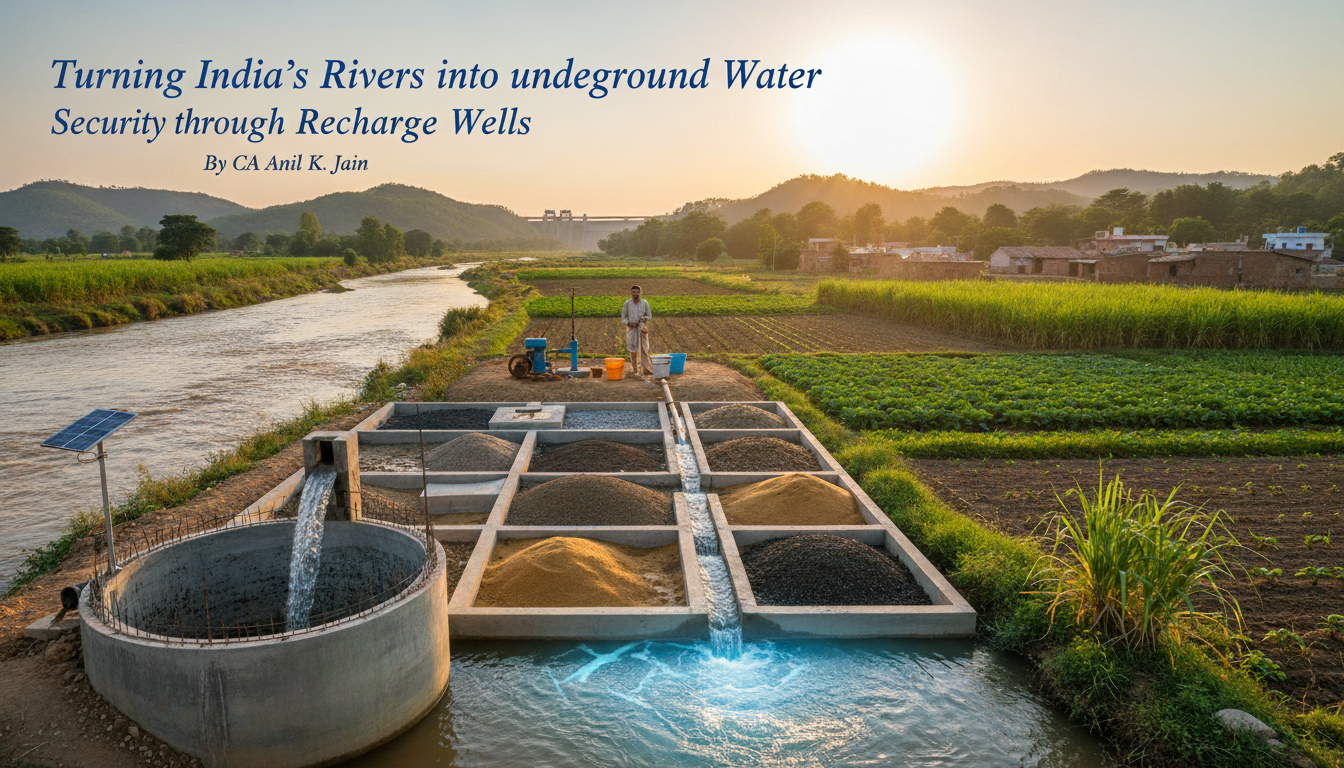
River Water Recharge Wells are scientifically designed wells constructed near rivers and water channels to capture surplus river water and recharge underground aquifers. The concept is closely related to Managed Aquifer Recharge, where excess water is filtered and directed below the ground for future use.
Unlike ordinary rainwater harvesting, which depends mainly on limited rainfall days, river water recharge can make use of surplus river flows, especially during monsoon and flood periods. Properly filtered river water can be channelled into recharge wells so that underground aquifers are replenished naturally and systematically.
Groundwater has become the backbone of India’s water supply. Farmers depend on borewells for irrigation, households depend on groundwater for daily use, and industries require reliable water for production. However, excessive extraction has caused groundwater levels to fall in many parts of the country. In several regions, water is now drawn from very deep levels, increasing cost, energy use and hardship.
River Water Recharge Wells can help stabilize groundwater levels by returning surplus water to underground aquifers. When water is stored underground, it is protected from evaporation losses that affect surface reservoirs. This makes underground storage a powerful long-term water security strategy for a hot and water-stressed country like India.
Water scarcity is not only an environmental problem. It is also an economic problem. Agriculture suffers when irrigation is unreliable. Industries face higher production costs when water supply is uncertain. Urban areas experience water stress as population and demand increase. Poor water management also affects public health, sanitation, employment and rural income.
For India to become a developed economy, water security must be treated as a foundation of national development. No country can achieve sustained growth without reliable water for farms, homes, factories, cities and ecosystems.
The process begins by identifying suitable sites along rivers through hydrogeological surveys. Surplus river water is diverted through filtration systems to remove silt, waste and impurities. The filtered water is then allowed to enter recharge wells, from where it moves into underground aquifers. Over time, the stored water spreads through natural underground channels and helps raise or stabilize the water table.
For successful implementation, recharge wells must be supported by proper engineering design, desilting arrangements, monitoring systems, water quality checks and regular maintenance. Poorly designed recharge structures may face clogging and reduced infiltration. Therefore, scientific planning is essential.
Several countries have used Managed Aquifer Recharge and related groundwater replenishment systems to strengthen water security. Countries such as the United States, Australia, Israel and South Africa have adopted different forms of recharge systems to store water underground and improve drought resilience. These examples show that the concept is practical, proven and adaptable to different climatic conditions.
India receives large volumes of river water during the monsoon season. Instead of allowing excessive surplus water to flow away unused, India can capture a reasonable portion and store it underground through recharge wells. This can help revive groundwater, reduce water stress and create a more reliable water system for the future.
The solution should not be seen as a replacement for all existing water policies. It should be integrated with rainwater harvesting, watershed development, pollution control, drip irrigation, efficient water use, river conservation and community participation. Together, these measures can create a stronger national water security framework.
Water scarcity is discussed as one of the major development challenges in the book Bharat: The Development Dilemma by CA Anil K Jain. The book examines 21 major challenges affecting India’s economic growth and proposes practical solutions for policymakers, UPSC aspirants, economists, entrepreneurs and development professionals.
Read more in Bharat: The Development Dilemma
Water scarcity in India is caused by several factors including population growth, excessive groundwater extraction, inefficient irrigation, pollution, erratic rainfall, poor storage systems and uneven distribution of water resources.
River Water Recharge Wells are structures designed to direct properly filtered surplus river water into underground aquifers, helping recharge groundwater and improve long-term water availability.
Recharge wells can help farmers by improving groundwater availability, reducing dependence on very deep borewells and supporting more reliable irrigation during dry periods.
Both are important. Rainwater harvesting captures rainfall, while river water recharge can use surplus river flows. River water recharge may offer greater reliability where surplus river water is available.
River Water Recharge Wells can become a major part of India’s water security strategy, but they should be combined with efficient water use, pollution control, irrigation reform, rainwater harvesting, river conservation and community participation.

For a detailed policy, scientific and implementation framework, read the book River Water Recharge Wells by CA Anil K Jain.
Learn more about CA Anil K Jain, Chartered Accountant, Economist, Author, Policy Researcher and the author of Bharat: The Development Dilemma and River Water Recharge Wells.
Author: CA Anil K Jain | Topic: Water Scarcity in India, River Water Recharge Wells, Groundwater Recharge and National Development
Ahimsa Foundation warmly welcomes information, photographs, literature, articles, and other meaningful contributions for publication on this web portal: www.jainsamaj.org | ✉ CAINDIA@HOTMAIL.COM
We also invite advertisements and sponsorship support to help us expand the reach of this social initiative and promote public awareness of Jain ideology.
 Related
 Related
Related
Related

Copyright © 2026 jainsamaj. All rights reserved.