



The Sikh Religion
By CA A. K. Jain
 |
1. Inception of Sikhism
Sikhism, the world’s fifth-largest religion, was founded at the end of the 15th century in the Punjab region of South Asia by Guru Nanak Dev Ji (1469–1539). Disillusioned with the ritualism and divisions within Hinduism and Islam, Guru Nanak preached a new spiritual path based on oneness of God (Ik Onkar), equality, and service to humanity. His teachings laid the foundation of Sikhism, which evolved over two centuries under the guidance of ten successive Gurus.
2. Progress of the Sikh Religion
From its spiritual inception under Guru Nanak Dev Ji, Sikhism evolved into a distinct, organized faith :
• Guru Angad Dev Ji formalized the Gurmukhi script, enabling the propagation of Sikh teachings.
• Guru Arjan Dev Ji, the fifth Guru, compiled the Adi Granth, the first version of the Sikh scriptures.
• Guru Hargobind Ji introduced the concept of Miri-Piri (temporal and spiritual authority).
• Guru Gobind Singh Ji, the tenth Guru, founded the Khalsa Panth in 1699, formalizing Sikh identity with five articles of faith (Five Ks) and ending the line of human Gurus by bestowing the Guru Granth Sahib as the eternal Guru.
3. The Sikh People
Sikhs are a vibrant and courageous community known for their resilience, integrity, hospitality, and martial valor. Though numerically a minority, their contributions are magnified in the fields of agriculture, armed forces, industry, literature, education, and philanthropy.
Major Sikh populations exist in Punjab (India), and global diasporas in Canada, UK, USA, Australia, and Malaysia have made significant cultural and economic contributions to their respective countries.
4. Religious Places of Sikhism
Sikhism reveres many sacred shrines, among which the most important are :
| Religious Place | Location | Significance |
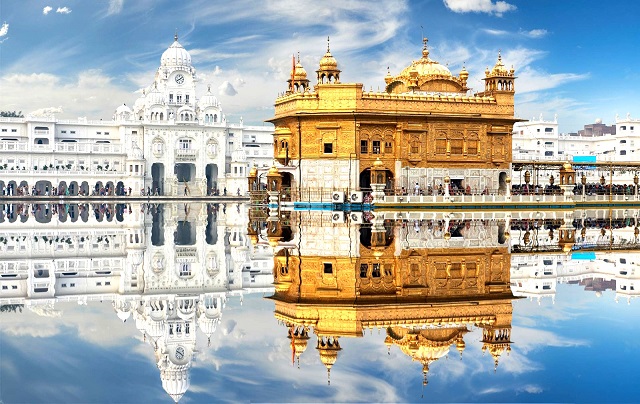
| Harmandir Sahib (Golden Temple) | Amritsar, Punjab | Holiest shrine, symbol of spiritual and cultural center of Sikhism |
| Takht Sri Keshgarh Sahib | Anandpur Sahib | Birthplace of Khalsa |
| Takht Sri Patna Sahib | Patna, Bihar | Birthplace of Guru Gobind Singh Ji |
| Takht Sri Hazur Sahib | Nanded, Maharashtra | Site where Guru Gobind Singh Ji passed away |
| Gurdwara Janam Asthan | Nankana Sahib, Pakistan | Birthplace of Guru Nanak Dev Ji |
5. Philosophy of Sikhism
The Sikh philosophy is a monotheistic spiritual framework rooted in equality, service, meditation, and community.
Core Tenets :
• Ik Onkar - One Universal Creator
• Naam Japna - Remembering God through meditation
• Kirat Karni - Earning an honest living
• Vand Chakna - Sharing with others
• Seva - Selfless service
Sikhism rejects caste, idolatry, and ritualism and upholds the dignity of all human beings irrespective of caste, creed, gender, or race.
6. Contributions to the Modern World
Sikhs have made significant contributions to :
a. Humanitarian Work :
• Sikh gurdwaras worldwide offer free community kitchens (langar) serving millions daily without discrimination.
• Organizations like Khalsa Aid provide disaster relief and humanitarian aid globally.
b. Global Peace and Unity :
• Sikh teachings emphasize universal brotherhood, religious tolerance, and gender equality.
c. Professional Excellence :
• Sikhs have excelled in politics, science, military, sports, and entrepreneurship across the world.
7. Important Sikh Gurus and Their Contributions
| Guru | Contribution |
| Guru Nanak Dev Ji | Founded Sikhism, preached equality and devotion to one God |
| Guru Angad Dev Ji | Developed Gurmukhi script, promoted physical health & education |
| Guru Amar Das Ji | Abolished caste distinctions, started festivals like Anand Karaj |
| Guru Ram Das Ji | Founded Amritsar city |
| Guru Arjan Dev Ji | Compiled Adi Granth, built Golden Temple, martyred for faith |
| Guru Hargobind Ji | Introduced martial spirit (Miri-Piri), built Akal Takht |
| Guru Har Rai Ji | Promoted environmental awareness, herbal medicine |
| Guru Har Krishan Ji | Served cholera victims in Delhi, died young |
| Guru Tegh Bahadur Ji | Martyred to protect religious freedom |
| Guru Gobind Singh Ji | Founded Khalsa, finalized Guru Granth Sahib as eternal Guru |
8. Important Sikhs Who Contributed to Humanity
| Name | Contribution |
| Baba Deep Singh Ji | Martyred defending Golden Temple |
| Shaheed Bhagat Singh | Iconic freedom fighter who challenged British colonial rule |
| Dr. Manmohan Singh | First Sikh Prime Minister of India (2004-2014) |
| Milkha Singh | Legendary athlete known as the “Flying Sikh” |
| Ravinder Singh (Khalsa Aid) | Founder of Khalsa Aid, global humanitarian assistance group |
| Harjit Sajjan | Canada’s first Sikh Defence Minister |
| Navdeep Singh Bains | Former Canadian Minister of Innovation, Science and Economic Development |
9. Major Sikh Festivals
| Festival | Significance |
| Gurpurab | Birth anniversaries of Sikh Gurus, especially Guru Nanak and Guru Gobind Singh |
| Vaisakhi | Foundation of Khalsa Panth in 1699, celebrated as Sikh New Year and harvest festival |
| Hola Mohalla | Demonstrates Sikh martial spirit through mock battles and displays |
| Maghi | Honors the martyrdom of 40 Sikhs who died fighting for Guru Gobind Singh Ji |
| Bandi Chhor Divas | Celebrates Guru Hargobind Ji’s release from prison, coincides with Diwali |
10. Contribution to India
Sikhs have played a critical role in shaping modern India :
a. Freedom Struggle :
• Despite being only ~2% of India’s population, more than 70% of those martyred in India’s independence movement were Sikhs.
b. Agriculture :
• Punjab, dominated by Sikh farmers, became the epicenter of India’s Green Revolution, making the country self-sufficient in food.
c. Armed Forces :
• The Sikh Regiment is one of the most decorated regiments in the Indian Army.
• Sikhs have historically played key roles in defending India's borders.
d. Politics and Governance :
• Sikhs have held high constitutional positions, including President (Giani Zail Singh) and Prime Minister (Dr. Manmohan Singh).
Conclusion
Sikhism is a shining example of a progressive, inclusive, and humanitarian religion. Its emphasis on equality, service, and justice has made it not just a spiritual path but a way of life that contributes meaningfully to global peace, national development, and human welfare. From langar halls feeding the hungry to brave soldiers guarding borders and global citizens leading innovation and philanthropy, the Sikh spirit of “Sarbat da Bhala” (welfare of all) continues to illuminate the world.
-----------------------------------------------------
Author : CA A. K. Jain
Cell : +91 98 100 46108
-----------------------------------------------------
Mail to : Ahimsa Foundation
www.jainsamaj.org
R13052025
