



“Security and Sovereignty: The Case for Israel”
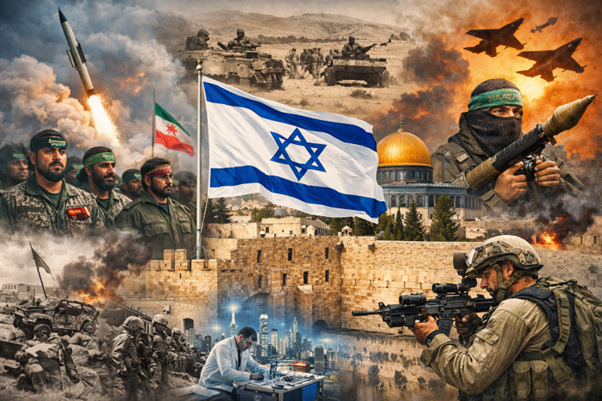
By: CA Anil K Jain
Mail: caindia@hotmail.com
The discourse surrounding peace in the Middle East has, for decades, been shaped by narratives of conflict resolution, territorial disputes, and the aspirations of various nations and peoples. While global attention often emphasizes justice, dignity, and security for the Arab world, comparatively less focus is placed on the fundamental and non-negotiable right of Israel—a small but sovereign nation—to exist in peace and security. This imbalance raises a crucial question: can lasting peace truly be achieved if the security concerns of all parties—especially Israel—are not equally acknowledged, respected, and guaranteed?
The Principle of Sovereign Equality:
At the core of international relations lies a simple yet powerful principle, every sovereign nation, regardless of its size or influence, has the inherent right to exist peacefully within recognized borders. Israel, established in 1948, is a legitimate member of the international community. Like any other nation, it is entitled to security, recognition, and freedom from existential threats. However, unlike most nations, Israel’s existence has been repeatedly challenged—militarily, politically, and ideologically—since its very inception.
A History of Conflict Since 1948:
To understand Israel’s security concerns, one must examine the historical record of conflicts and hostilities that have disturbed its peaceful environment over the decades.
1. The 1948 Arab-Israeli War:
Immediately following Israel’s declaration of independence, it was invaded by a coalition of Egypt, Jordan, Syria, Iraq, and Lebanon. This marked the beginning of a prolonged period of hostility and established a pattern of regional opposition to Israel’s existence.
2. The 1956 Suez Crisis:
In 1956, tensions escalated when Egypt nationalized the Suez Canal. Israel, in coordination with France and the United Kingdom, engaged militarily with Egypt. This crisis demonstrated the fragility of peace and the strategic vulnerabilities Israel faced.
3. The 1967 Six-Day War:
Facing mobilisation and threats from Egypt, Syria, and Jordan, Israel launched a pre-emptive strike. The war resulted in significant territorial changes and further deepened regional tensions, reinforcing Israel’s belief that its survival depends on preparedness and decisive action.
4. The 1973 Yom Kippur War:
Israel was attacked unexpectedly by Egypt and Syria on one of its holiest days. The war caused heavy casualties and underscored Israel’s ongoing vulnerability despite prior military successes.
5. Lebanon Conflicts:
From the 1970s onward, Israel faced threats from armed groups operating in Lebanon, including the Palestine Liberation Organization (PLO) and later Hezbollah, which is supported by Iran. These conflicts brought sustained violence to Israel’s northern borders.
6. The First and Second Intifadas:
The uprisings between Israelis and Palestinians (1987–1993 and 2000–2005) led to widespread violence, including terror attacks and military responses, deeply affecting civilian life and internal security within Israel.
7. Gaza Conflicts and Ongoing Hostilities:
After Israel’s withdrawal from Gaza in 2005, the territory came under the control of Hamas, which does not recognise Israel’s right to exist. Repeated conflicts and rocket attacks on Israeli cities have continued to threaten civilian populations.
8. Iran’s Expanding Regional Role:
In recent decades, Iran has played a significant role in regional tensions through its support of militant groups such as Hezbollah and Hamas, as well as its broader strategic opposition to Israel. This has added a new and complex dimension to Israel’s security challenges.
A Nation Under Constant Threat:
This historical pattern reveals a consistent reality: Israel has faced repeated wars, surprise attacks, terrorism, and ideological hostility from both neighboring states and non-state actors.
Countries involved in conflicts with Israel over time include:
In addition, organizations such as Hamas, Hezbollah, and the PLO have contributed significantly to ongoing instability.
For Israel, security is not an abstract concept—it is a daily necessity.
The Question of Security Guarantees:
In this context, the idea of relying on uncertain or politically motivated assurances—particularly from actors whose policies have historically opposed Israel—raises serious concerns. A sustainable peace framework cannot be built on fragile or contradictory guarantees. It must instead be grounded in:
Peace must be reciprocal. It cannot demand concessions from Israel without offering credible and enforceable guarantees of its safety and survival.
Israel’s Contributions to Humanity: A Deep Dive into Technological Leadership and Innovation
Despite decades of geopolitical challenges, security pressures, and limited natural resources, Israel has transformed itself into one of the world’s most dynamic innovation-driven economies. Often referred to as the “Start-up Nation,” Israel exemplifies how adversity, when combined with knowledge, discipline, and entrepreneurial spirit, can produce extraordinary outcomes. What makes Israel unique is not just its technological success, but the breadth of its contributions across multiple sectors—ranging from cybersecurity and agriculture to medicine and advanced scientific research.
1. Advanced Technology and Cybersecurity
Israel is a global powerhouse in high technology and cybersecurity, with one of the highest concentrations of start-ups per capita in the world.
2. Agricultural Innovation and Water Management
Perhaps one of Israel’s most remarkable achievements lies in transforming arid and desert land into productive agricultural zones.
3. Medical Research and Healthcare Advancements:
Israel has made profound contributions to global healthcare through cutting-edge research, innovation, and biotechnology.
4. Scientific and Academic Excellence:
Israel’s academic institutions and research centers are among the most respected in the world.
5. Entrepreneurship and Start-up Ecosystem
A defining feature of Israel’s success is its entrepreneurial culture.
6. Space and Advanced Engineering
Israel is also a participant in advanced aerospace and space technologies.
A Society Driven by Knowledge and Purpose:
These achievements are not accidental. They are the result of:
Israel has demonstrated how a nation with limited natural resources can become rich in intellectual capital and technological prowess.
Israel’s contributions to humanity extend far beyond its geographic boundaries. Its innovations have improved agricultural productivity in developing nations, strengthened global cybersecurity, advanced medical science, and contributed to sustainable resource management.
Such a nation—committed to progress, human welfare, and global development—deserves not to live under constant threat, but to thrive in an environment of peace and security.
A world that benefits from Israel’s innovations must also recognize and support its right to exist safely and contribute even more to the betterment of humanity.
The Moral and Human Dimension:
Beyond geopolitics, there is a fundamental moral question: do the people of Israel not deserve the same right to live in peace and security as any other people?
Generations of Israelis have grown up under the shadow of conflict—facing missile threats, terrorism, and uncertainty. Like all human beings, they seek stability, dignity, and the opportunity to build a better future.
To question or undermine Israel’s right to exist is not merely a political stance—it is a challenge to the universal principle of human rights.
Toward a Balanced Vision of Peace:
True and lasting peace in the Middle East cannot be selective. It must be inclusive and balanced, recognizing the legitimate rights and aspirations of all nations and peoples.
This includes:
Peace cannot be achieved by ignoring one side’s fears or by imposing unequal expectations. It must be built on fairness, mutual respect, and shared responsibility.
A Path Forward:
The international community has a vital role to play in reshaping the narrative. Rather than perpetuating divisions, it must advocate for a framework where:
Israel has shown, through various diplomatic initiatives and normalization efforts, that it is willing to engage constructively with its neighbours when genuine opportunities for peace arise.
Conclusion:
The pursuit of peace in the Middle East is both necessary and urgent. However, peace must be more than an aspiration—it must be grounded in reality, history, and fairness. The historical record since 1948 clearly demonstrates that Israel has faced persistent threats to its existence. This reality cannot be ignored when shaping future policies or peace initiatives.
For peace to be genuine, durable, and meaningful, Israel’s right to exist—and to do so in complete security—must be unequivocally recognized and guaranteed by the entire world. A secure Israel is not an obstacle to peace; it is an essential foundation for it. Only when all nations in the region, including Israel, are assured of their safety and sovereignty can the Middle East move toward a future defined not by conflict, but by cooperation, stability, and shared prosperity.
..........................................................
The author of this article, C.A. Anil K. Jain ( caindia@hotmail.com ) is a highly acclaimed Chartered Accountant with over four decades of professional experience. He is widely recognized for his expertise in financial and asset planning, taxation, international investments, and business growth strategies. Beyond advisory work. He actively contributes to national economic discourse through policy representations to the Government of India, frequent appearances on television and radio, and extensive writing. He is also the author of the acclaimed books Bharat: The Development Dilemma and River Water Recharge Wells, reflecting his commitment to India’s economic development and sustainable water solutions.

Mail to : Ahimsa Foundation
www.jainsamaj.org
R08042026
