


Islam: Inception & Evolution
By CA A. K. Jain
 |
1. Inception of Islam
Islam is a monotheistic Abrahamic religion that emerged in the early 7th century CE in the Arabian Peninsula. It was founded by Prophet Muhammad (peace be upon him), born in 570 CE in Mecca (present-day Saudi Arabia). The first revelation was received by him in 610 CE in the Cave of Hira through the angel Jibreel (Gabriel).
The core message of Islam is the belief in one God (Allah), and Muhammad as the last prophet. The Qur'an, Islam’s holy book, is considered the literal word of God, revealed over 23 years.
2. Progress and Spread of Islam
After Prophet Muhammad's death in 632 CE, Islam rapidly expanded across the Middle East, North Africa, parts of Europe, and Asia. Key periods of expansion include:
• Rashidun Caliphate (632–661 CE) - The rightly guided caliphs who spread Islam through governance and justice.
• Umayyad and Abbasid Dynasties - Established Islamic rule across vast territories, promoting knowledge, science, and architecture.
• Mughal Empire in India (1526–1857) - Played a major role in shaping Indo-Islamic culture.
Today, Islam is the second-largest religion in the world, with over 1.9 billion adherents globally.
3. People and Communities
Muslims, the followers of Islam, are diverse and live across continents, with large populations in:
• Indonesia (world’s largest Muslim population)
• Pakistan, India, Bangladesh
• Middle East and North Africa
• Turkey, Iran, Central Asia, Sub-Saharan Africa
• Significant minorities in Europe and North America
Islam has two major sects :
• Sunni (85-90%)
• Shia (10-15%)
Both believe in the same Quran but differ in political and spiritual leadership traditions.
4. Religious Places in Islam
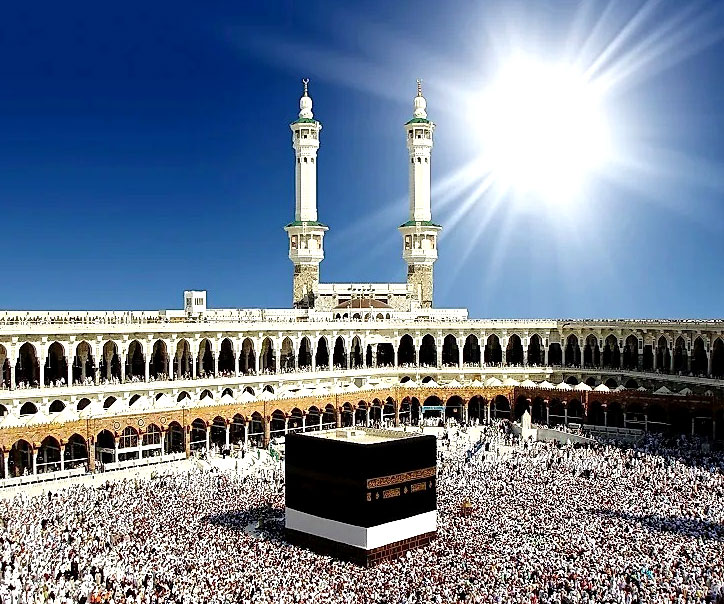
• Masjid al-Haram (Mecca) - The holiest site, home to the Kaaba, the direction of Muslim prayer (Qibla).
• Al-Masjid an-Nabawi (Medina) - The mosque of the Prophet.
• Al-Aqsa Mosque (Jerusalem) - Islam’s third holiest site.
• Other important mosques include:
o Blue Mosque (Istanbul)
o Faisal Mosque (Islamabad)
o Jama Masjid (Delhi)
5. Philosophy of Islam
The philosophy of Islam is based on:
• Tawhid (Oneness of God)
• Justice (‘Adl)
• Compassion (Rahmah)
• Accountability in the hereafter
• Balance between material and spiritual life
The Five Pillars of Islam form the foundation:
1. Shahadah - Faith in one God and Muhammad as his messenger.
2. Salah - Prayer five times a day.
3. Zakat - Giving to charity.
4. Sawm - Fasting during Ramadan.
5. Hajj - Pilgrimage to Mecca once in a lifetime if able.
6. Symbol of Islam
While Islam does not have an official religious symbol, the Crescent Moon and Star is commonly associated with Islamic identity, though it has cultural rather than scriptural origin.
7. Contributions to the Modern World
Science & Mathematics:
• Al-Khwarizmi - Father of Algebra.
• Ibn Sina (Avicenna) - Pioneer in medicine.
• Alhazen (Ibn al-Haytham) - Optics and experimental science.
Art & Architecture :
• Dome of the Rock, Taj Mahal, Islamic calligraphy and geometric art.
Philosophy & Literature:
• Works of Al-Ghazali, Rumi, Averroes (Ibn Rushd).
• Rich poetry and philosophical traditions.
Political Thought :
• Concepts of justice, welfare state, and community ethics influenced many governance models.
8. Important Gurus and Thinkers in Islam
While Islam doesn’t have "gurus" in the Indian sense, several key figures have shaped Islamic thought:
• Prophet Muhammad (PBUH) - Central religious figure.
• Imam Ali - Revered by both Shia and Sunni for his knowledge and justice.
• Imam Abu Hanifa, Malik, Shafi’i, Hanbal - Founders of major Sunni jurisprudence schools.
• Al-Ghazali - Theologian and philosopher.
• Jalaluddin Rumi - Sufi mystic and poet.
• Imam Hussain - Symbol of resistance and justice.
9. Important Festivals
• Eid al-Fitr - Celebrated at the end of Ramadan; festival of breaking the fast.
• Eid al-Adha - Commemorates the sacrifice of Prophet Ibrahim.
• Milad-un-Nabi - Celebrates the birth of Prophet Muhammad.
• Ashura - Especially significant for Shia Muslims; commemorates the martyrdom of Imam Hussain.
10. Contribution of Islam to India
|
Contribution Area |
Description |
| Architecture | Mughal architecture - Taj Mahal, Red Fort, Fatehpur Sikri |
| Language | Development of Urdu language (Persian + Arabic + local dialects) |
| Cuisine | Rich Mughlai cuisine, kebabs, biryanis, sweets |
| Music | Sufi music, Qawwali (Amir Khusrau's contributions) |
| Education | Establishment of madrasas, libraries, and centers of learning |
| Trade | Islamic merchants contributed to India’s global trade networks |
| Social | Harmony Shared Sufi traditions built bridges across communities |
| Freedom Movement | Leaders like Maulana Abul Kalam Azad contributed to India's independence |
Conclusion
Islam is not only a religion but a complete way of life that encompasses spiritual, social, and ethical dimensions. Its contributions to world civilization - from science and art to philosophy and governance - are immense. In India, it has deeply influenced culture, language, food, and thought. Islam continues to be a guiding force for millions, advocating peace, knowledge, and justice.
-----------------------------------------------------
Author : CA A. K. Jain
Cell : +91 98 100 46108
-----------------------------------------------------
Mail to : Ahimsa Foundation
www.jainsamaj.org
R17052025
