Ahimsa Foundation Proposes 21-Point Charter for Sustainable Peace - 27.03.2026
Ahimsa Foundation Proposes 21-Point Charter for Sustainable Peace
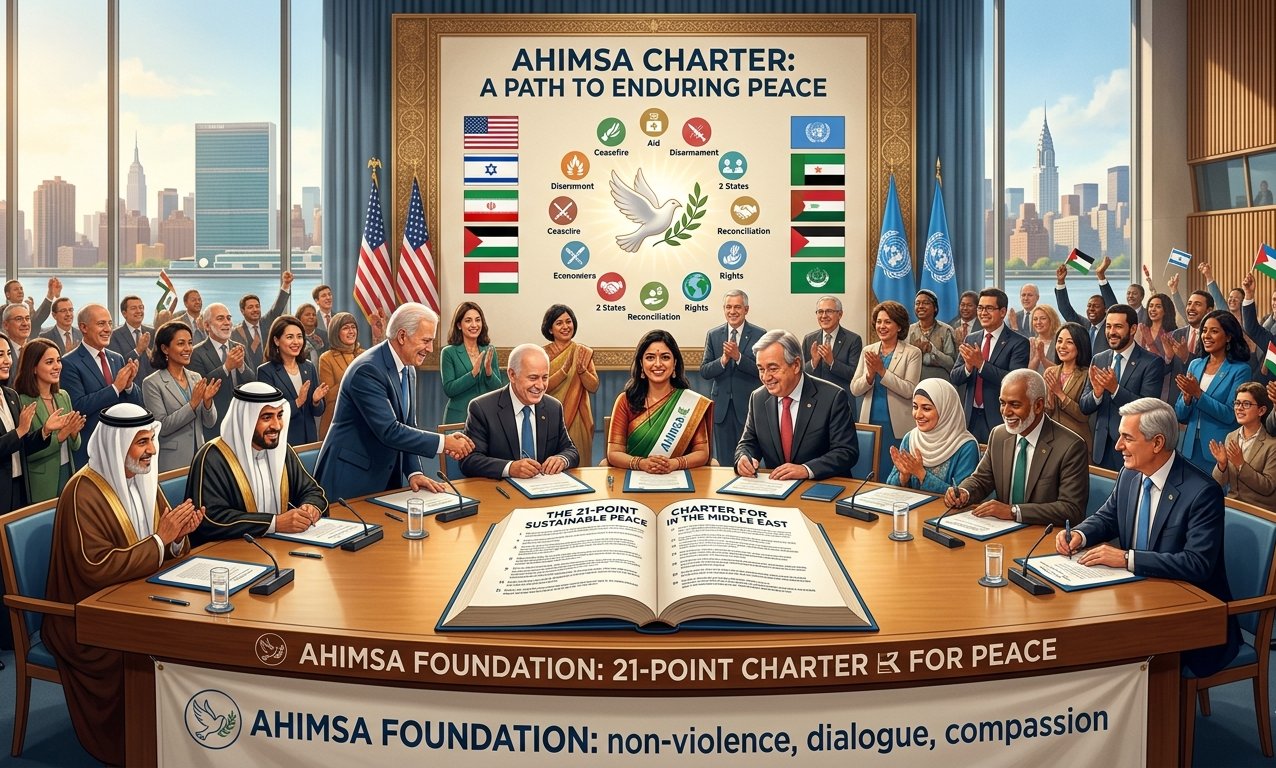
It is a profound honour to present and elaborate upon this charter on behalf of the Ahimsa Foundation. Rooted in the timeless and universal principle of Ahimsa—non-violence in thought, word, and action—this framework is offered in sincere service to humanity and the preservation of global peace.
Guided by the belief that true and lasting peace cannot be achieved through force, but only through compassion, justice, and dialogue, this 21-point charter seeks to provide a comprehensive pathway toward de-escalation and reconciliation. It begins with urgent, life-saving measures aimed at halting violence and protecting civilians, and progressively advances toward deeper structural reforms necessary to address the root causes of conflict.
This proposal is not merely a response to immediate hostilities, but a long-term vision for stability, dignity, and coexistence in the Middle East. It recognizes that sustainable peace requires collective responsibility, moral courage, and a commitment to non-violence at every level of decision-making. Through this charter, the Ahimsa Foundation humbly calls upon all parties and the international community to rise above division, to choose dialogue over destruction, and to work together in building a future grounded in mutual respect and shared humanity.
I. Immediate Actions and Humanitarian Relief
1. Ceasefire and De-escalation:
All kinetic military operations must stop. This includes rocket fire, airstrikes, and ground manoeuvres. To ensure honesty, a "Joint Monitoring Centre" involving neutral parties (like Scandinavia or Switzerland) should verify violations in real-time.
2. Unconditional Release:
Peace cannot be built on the suffering of families. This point demands the release of all hostages and political prisoners held without due process. It is a gesture of "good faith" that signals a transition from hostage-taking to diplomacy.
3. Humanitarian Access:
Politics must stop at the edge of the dinner plate. This requires opening all border crossings (Rafah, Kerem Shalom, etc.) for a steady flow of aid. International NGOs must have "sovereign immunity" to operate clinics and food centres without fear of being targeted.
4. Protection of Civilians:
Parties must formally sign a "Civilians First" pledge. This means zero military use of schools, hospitals, or houses of worship. Any party using human shields or targeting civilian infrastructure loses its seat at the negotiating table.
II. Establishing Security and Trust:
5. International Peacekeeping:
A UN-mandated "Blue Helmet" force, composed of nations that have no historical stake in the conflict, should patrol borders. Their presence acts as a "tripwire" to prevent surprise incursions and provides a sense of security to terrified populations.
6. Demilitarized Zones (DMZs):
Establishing "buffer zones" where no heavy weaponry is allowed. This reduces "border friction" and prevents the proximity of opposing forces, which often leads to accidental escalations.
7. Arms Control and Monitoring:
A regional registry of weapons. This requires Iran and America to agree on transparency regarding the hardware they provide to their respective allies, ensuring that defensive tools don't become offensive threats.
8. Rehabilitation of Essential Services:
Peace is hard to maintain in the dark. Priority #1 is restoring the power grid and desalination plants. When people have water, electricity, and sewage services, the "desperation index" drops, weakening the recruitment power of extremist groups.
III. Political and Diplomatic Framework:
9. Direct and Indirect Dialogue:
Breaking the "no-talk" taboo. Even if leaders won't shake hands yet, "Track II Diplomacy" (back-channel talks between academics and retired generals) must be constant to prevent misunderstandings from turning into wars.
10. Two-State Solution Commitment:
A clear roadmap with a hard deadline. This requires Israel to halt settlement expansion and the Palestinian leadership to unify under a single, non-violent democratic entity.
11. State Legitimacy:
Mutual recognition. Israel recognises the State of Palestine; Iran and all Arab neighbours recognise the State of Israel. This removes the existential "erasure" rhetoric that fuels the conflict.
12. Status of Jerusalem:
A "City for Two Peoples, Three Faiths." Instead of a wall, Jerusalem should be an open city with shared municipal administration, ensuring that Jews, Muslims, and Christians have unfettered access to their holiest sites.
13. United Nations Role:
The UN must move from being a "debating club" to an enforcer. This involves reform where the Security Council cannot veto humanitarian interventions or peace-monitoring missions.
IV. Addressing Regional Stability
14. Regional Security Forum:
Modelled after the "Helsinki Accords," this would be a permanent table where Iran, Saudi Arabia, Israel, and Turkey sit together to discuss regional "rules of the road" to prevent a broader Middle East war.
15. Non-Interference
States must stop using "proxies." Every nation pledges to stop funding or arming militias in other countries. Sovereignty must be absolute.
16. Arms Proliferation Dialogue:
Specifically targeting long-range missiles and drone technology. A regional "Arms Limitation Treaty" would prevent an expensive and dangerous arms race that drains the region’s wealth.
V. Economic Recovery and Human Rights
17. Economic Reconstruction Fund:
A "Marshall Plan for the Middle East." Wealthy nations and regional oil-producing giants contribute to a multi-billion dollar fund to build tech hubs, universities, and factories, giving the youth a future worth living for.
18. Lifting Economic Restrictions:
The "Peace Dividend." As security milestones are met, blockades are lifted. Goods must flow freely so that Gaza and the West Bank can become economic engines rather than aid-dependent territories.
19. Human Rights Accountability:
A neutral tribunal to investigate war crimes from all sides. Peace without justice is just a pause in the fighting. Victims on all sides need to feel that their losses have been acknowledged by the law.
20. Rights of Refugees:
A final, compassionate settlement for the millions of displaced people. This involves a combination of financial compensation, "Right of Return" to a future Palestinian state, and integration into host countries with full citizenship.
VI. Sustaining the Peace:
21. Truth, Reconciliation, and Justice:
Inspired by South Africa, this involves public hearings where people share their stories. It moves the narrative from "us vs. them" to a shared history of human suffering and a shared commitment to "Never Again."
"In conclusion, this 21-Point Ahimsa Charter transcends mere policy; it is a profound moral appeal to the collective conscience of all nations. It serves as a stark reminder that enduring peace is never the product of force, fear, or domination, but is forged through the crucible of dialogue, compassion, and shared responsibility. At this pivotal juncture in history, leaders face a definitive choice: to persist on a trajectory that risks irreversible catastrophe for humanity and the Earth, or to embrace the principles of non-violence and cooperation for the sake of those yet born. The path of Ahimsa may be the most challenging, but it remains the only viable road toward a just, sustainable, and truly human future."
It is a profound honour to present and elaborate upon this charter on behalf of the Ahimsa Foundation. Rooted in the timeless and universal principle of Ahimsa—non-violence in thought, word, and action—this framework is offered in sincere service to humanity and the preservation of global peace.
Guided by the belief that true and lasting peace cannot be achieved through force, but only through compassion, justice, and dialogue, this 21-point charter seeks to provide a comprehensive pathway toward de-escalation and reconciliation. It begins with urgent, life-saving measures aimed at halting violence and protecting civilians, and progressively advances toward deeper structural reforms necessary to address the root causes of conflict.
This proposal is not merely a response to immediate hostilities, but a long-term vision for stability, dignity, and coexistence in the Middle East. It recognizes that sustainable peace requires collective responsibility, moral courage, and a commitment to non-violence at every level of decision-making. Through this charter, the Ahimsa Foundation humbly calls upon all parties and the international community to rise above division, to choose dialogue over destruction, and to work together in building a future grounded in mutual respect and shared humanity.
I. Immediate Actions and Humanitarian Relief
1. Ceasefire and De-escalation:
All kinetic military operations must stop. This includes rocket fire, airstrikes, and ground manoeuvres. To ensure honesty, a "Joint Monitoring Centre" involving neutral parties (like Scandinavia or Switzerland) should verify violations in real-time.
2. Unconditional Release:
Peace cannot be built on the suffering of families. This point demands the release of all hostages and political prisoners held without due process. It is a gesture of "good faith" that signals a transition from hostage-taking to diplomacy.
3. Humanitarian Access:
Politics must stop at the edge of the dinner plate. This requires opening all border crossings (Rafah, Kerem Shalom, etc.) for a steady flow of aid. International NGOs must have "sovereign immunity" to operate clinics and food centres without fear of being targeted.
4. Protection of Civilians:
Parties must formally sign a "Civilians First" pledge. This means zero military use of schools, hospitals, or houses of worship. Any party using human shields or targeting civilian infrastructure loses its seat at the negotiating table.
II. Establishing Security and Trust:
5. International Peacekeeping:
A UN-mandated "Blue Helmet" force, composed of nations that have no historical stake in the conflict, should patrol borders. Their presence acts as a "tripwire" to prevent surprise incursions and provides a sense of security to terrified populations.
6. Demilitarized Zones (DMZs):
Establishing "buffer zones" where no heavy weaponry is allowed. This reduces "border friction" and prevents the proximity of opposing forces, which often leads to accidental escalations.
7. Arms Control and Monitoring:
A regional registry of weapons. This requires Iran and America to agree on transparency regarding the hardware they provide to their respective allies, ensuring that defensive tools don't become offensive threats.
8. Rehabilitation of Essential Services:
Peace is hard to maintain in the dark. Priority #1 is restoring the power grid and desalination plants. When people have water, electricity, and sewage services, the "desperation index" drops, weakening the recruitment power of extremist groups.
III. Political and Diplomatic Framework:
9. Direct and Indirect Dialogue:
Breaking the "no-talk" taboo. Even if leaders won't shake hands yet, "Track II Diplomacy" (back-channel talks between academics and retired generals) must be constant to prevent misunderstandings from turning into wars.
10. Two-State Solution Commitment:
A clear roadmap with a hard deadline. This requires Israel to halt settlement expansion and the Palestinian leadership to unify under a single, non-violent democratic entity.
11. State Legitimacy:
Mutual recognition. Israel recognises the State of Palestine; Iran and all Arab neighbours recognise the State of Israel. This removes the existential "erasure" rhetoric that fuels the conflict.
12. Status of Jerusalem:
A "City for Two Peoples, Three Faiths." Instead of a wall, Jerusalem should be an open city with shared municipal administration, ensuring that Jews, Muslims, and Christians have unfettered access to their holiest sites.
13. United Nations Role:
The UN must move from being a "debating club" to an enforcer. This involves reform where the Security Council cannot veto humanitarian interventions or peace-monitoring missions.
IV. Addressing Regional Stability
14. Regional Security Forum:
Modelled after the "Helsinki Accords," this would be a permanent table where Iran, Saudi Arabia, Israel, and Turkey sit together to discuss regional "rules of the road" to prevent a broader Middle East war.
15. Non-Interference:
States must stop using "proxies." Every nation pledges to stop funding or arming militias in other countries. Sovereignty must be absolute.
16. Arms Proliferation Dialogue:
Specifically targeting long-range missiles and drone technology. A regional "Arms Limitation Treaty" would prevent an expensive and dangerous arms race that drains the region’s wealth.
V. Economic Recovery and Human Rights
17. Economic Reconstruction Fund:
A "Marshall Plan for the Middle East." Wealthy nations and regional oil-producing giants contribute to a multi-billion dollar fund to build tech hubs, universities, and factories, giving the youth a future worth living for.
18. Lifting Economic Restrictions:
The "Peace Dividend." As security milestones are met, blockades are lifted. Goods must flow freely so that Gaza and the West Bank can become economic engines rather than aid-dependent territories.
19. Human Rights Accountability:
A neutral tribunal to investigate war crimes from all sides. Peace without justice is just a pause in the fighting. Victims on all sides need to feel that their losses have been acknowledged by the law.
20. Rights of Refugees:
A final, compassionate settlement for the millions of displaced people. This involves a combination of financial compensation, "Right of Return" to a future Palestinian state, and integration into host countries with full citizenship.
VI. Sustaining the Peace:
21. Truth, Reconciliation, and Justice:
Inspired by South Africa, this involves public hearings where people share their stories. It moves the narrative from "us vs. them" to a shared history of human suffering and a shared commitment to "Never Again."
"In conclusion, this 21-Point Ahimsa Charter transcends mere policy; it is a profound moral appeal to the collective conscience of all nations. It serves as a stark reminder that enduring peace is never the product of force, fear, or domination, but is forged through the crucible of dialogue, compassion, and shared responsibility. At this pivotal juncture in history, leaders face a definitive choice: to persist on a trajectory that risks irreversible catastrophe for humanity and the Earth, or to embrace the principles of non-violence and cooperation for the sake of those yet born. The path of Ahimsa may be the most challenging, but it remains the only viable road toward a just, sustainable, and truly human future."
CA Anil K Jain ----------------------------------------------------- Mail to : Ahimsa Foundation |