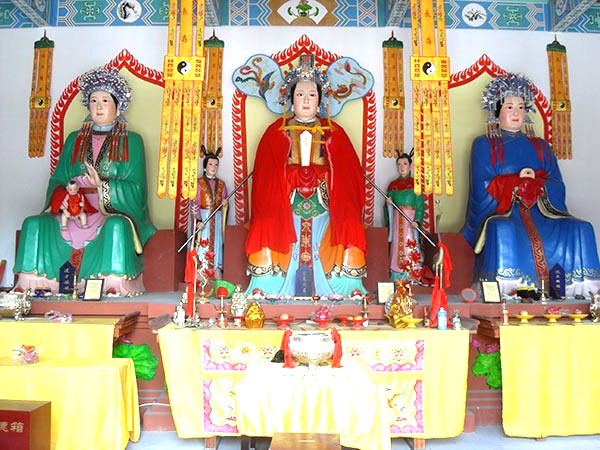
Chinese Folk Religion
By CA A. K. Jain
Introduction
Rooted in millennia of cultural memory, Chinese Folk Religion (CFR) is not a codified system but a vibrant mosaic of ancestral worship, deity veneration, spiritual rituals, nature reverence, and moral philosophy. It is one of the most widely practiced and enduring belief systems in the world, yet remains deeply interwoven into daily life, often unconsciously practiced by those who may not even label themselves “religious.” It exists parallel to and often blended with Taoism, Confucianism, and Buddhism.
Today, despite China's rapid modernization and decades of official atheism, Chinese folk religion continues to flourish-quietly shaping festivals, customs, and community identity.
Origins and Evolution
Chinese Folk Religion is as old as Chinese civilization itself, with origins dating back over 4,000 years to the Shang Dynasty (1600-1046 BCE). Early forms included :
• Shamanic practices
• Oracle bone divination
• Ancestor worship
• Nature spirit veneration
Over time, it absorbed elements from :
• Taoism : Offering cosmological principles, gods, and alchemical ideas
• Buddhism : Especially ritual, reincarnation concepts, and Bodhisattva figures
• Confucianism : Providing social ethics, filial piety, and ritual propriety
Despite official suppression during certain periods (e.g., the Cultural Revolution), CFR survived through community rituals, festivals, and household practices—remaining one of the most persistent spiritual systems on Earth.
Core Beliefs and Philosophy
Chinese Folk Religion is non-dogmatic, polytheistic, and pragmatic. Its core beliefs include :
• Ancestral Veneration : Deceased ancestors continue to influence the living and must be honored through offerings and rituals.
• Heaven (Tian 天) : A supreme cosmic force that governs moral order and destiny.
• Yin-Yang and the Five Elements : Balance and harmony in nature and society are essential.
• Spirits (Shen 神 and Gui 鬼) : Everything has a spirit; “shen” are beneficial, “gui” are restless or harmful spirits.
• Deified Heroes and Local Gods : Historical figures often become local gods or protectors.
It emphasizes ritual propriety, social harmony, family continuity, and cosmic balance.
Religious Figures and Teachers
There is no singular priesthood, but CFR has:
• Spirit mediums (巫wū) and shamans, who communicate with gods and spirits
• Daoist priests (道士dàoshì) who perform rituals and exorcisms
• Temple caretakers and diviners, who oversee sacred spaces and interpret omens
• Feng Shui masters, who guide energy alignment in homes, graves, and buildings
The wisdom of elders and local practitioners often carries more influence than institutional clergy.
Sacred Places and Shrines
CFR is practiced in homes, temples, ancestral halls, mountaintops, and roadside altars. Sacred places are often simple yet spiritually powerful :
| Sacred Place |
Significance |
| Home Altars |
Used daily for ancestor offerings and household gods |
| Ancestral Halls (祠堂) |
Maintain family lineage and veneration rituals |
| Local Temples |
Honor gods like Mazu, Guan Yu, and Earth Gods |
| Mountains and Sacred Trees |
Believed to be dwellings of powerful spirits |
Famous sacred sites include Mount Tai, Mount Hua, and Mount Wudang-all rich in Taoist and folk religious traditions.
Deities and Popular Gods
Chinese Folk Religion recognizes hundreds of gods, spirits, and immortals, including :
| Deity |
Role |
| Tudi Gong (Earth God) |
Local protector of villages and land |
| Mazu (Sea Goddess) |
Patron of sailors and fishermen |
| Guandi (God of War) |
Deified form of General Guan Yu |
| Zao Jun (Kitchen God) |
Reports household behavior to Heaven annually |
| Cheng Huang (City God) |
Oversees morality in towns and cities |
| Caishen (God of Wealth) |
Invoked for prosperity during New Year |
Deities may have overlapping jurisdictions and are often personalized by local belief.
Rituals and Practices
Chinese Folk Religion is deeply ritualistic, emphasizing offerings, symbols, and divination :
• Ancestor Worship : Offerings of food, incense, and joss paper at home altars and graves.
• Spirit Mediumship : Possession rituals for healing, guidance, or exorcism.
• Burning Paper Money : To ensure ancestors and spirits have wealth in the afterlife.
• Divination : Using moon blocks, sticks, and astrology to ask deities for direction.
• Ritual Cleansing : Includes incense burning, food offerings, and temple processions.
These are performed regularly, especially during festivals, family milestones, or when facing misfortune.
Festivals and Celebrations
Chinese folk beliefs are central to many Chinese festivals, blending religious ritual with social life :
| Festival |
Time |
Significance |
| Lunar New Year |
January / February |
Ancestral veneration, honoring Kitchen God, cleansing old luck |
| Qingming Festival (Tomb-Sweeping Day) |
April |
Cleaning graves, offering to ancestors |
| Ghost Festival (Zhongyuan) |
August |
Appeasing hungry spirits with rituals and offerings |
| Mid-Autumn Festival |
September |
Moon worship and family reunion |
| Lantern Festival |
15th day of Lunar New Year |
Light guiding spirits and prayers for peace |
Each festival reflects an interaction with spiritual forces, blending public spectacle with private prayer.
Followers and Global Presence
Estimating followers is complex due to :
• Overlap with Taoism, Buddhism, and Confucianism
• Many people not identifying as “religious” despite practicing rituals
Still, experts estimate :
• Over 400-500 million people in China and among the Chinese diaspora engage in CFR-related practices
• Large communities in Taiwan, Hong Kong, Singapore, Malaysia, and Indonesia
In Taiwan alone, more than 80% of the population engages in some form of Chinese folk religious ritual.
Modern Challenges and Revival
During the 20th century, CFR faced persecution and suppression under communist rule. Temples were destroyed, and spiritual leaders were silenced during the Cultural Revolution.
However, since the 1980s, there has been a strong revival:
• Temples rebuilt and reopened
• Festivals openly celebrated again
• Traditional practices re-integrated into community life
• Cultural heritage protection extended to temple arts and rituals
Even among the youth, traditional values, feng shui, and ancestor veneration remain deeply respected.
Contributions to Chinese Society and Humanity
• Social Harmony : Reinforces family structure, filial piety, and respect for elders
• Environmental Ethics : Many local gods and rituals protect forests, rivers, and mountains
• Cultural Continuity : Provides identity and cohesion amid rapid modernization
• Interfaith Influence: A major source of syncretism in East Asian spiritual traditions
Conclusion
Chinese Folk Religion is not just a belief system-it is the living soul of Chinese civilization, reflecting how ordinary people seek to understand the cosmos, honor their roots, and protect their future. Rooted in ancestral love, spiritual practicality, and cosmic order, it continues to evolve while holding firm to its sacred traditions.
In a world that increasingly seeks meaning beyond institutions, the quiet rituals of CFR remind us that spirituality is not only found in temples but in family meals, seasonal rhythms, and the burning of incense at twilight.
-----------------------------------------------------
Author : CA A. K. Jain
Cell : +91 98 100 46108
-----------------------------------------------------
Mail to : Ahimsa Foundation
www.jainsamaj.org
R26052025