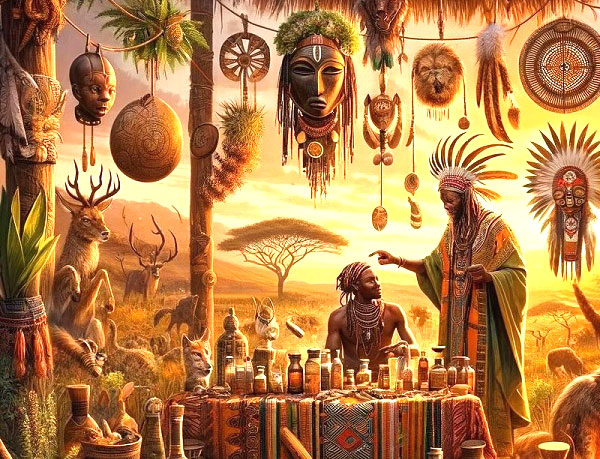
African Traditional Religions
By CA A. K. Jain
Introduction
Africa, often referred to as the cradle of humanity, is also home to a profound spiritual legacy-African Traditional Religions (ATRs). These faith systems are deeply embedded in the culture, environment, and history of the people. Unlike organized global religions, ATRs are not bound by single scriptures or centralized authorities but thrive through oral traditions, community practices, and ancestral heritage. They represent a collective wisdom passed down through generations, offering a unique lens into Africa's understanding of life, death, morality, and the divine.
Origins and Historical Context
The roots of ATRs trace back thousands of years, predating the arrival of Christianity and Islam. These indigenous beliefs evolved locally in different regions, influenced by natural surroundings, clan histories, and cosmological interpretations. While there is no singular founder or date of origin, ATRs are considered among the oldest religious practices in the world.
The historical significance of ATRs lies in their role in shaping governance, conflict resolution, health systems, and environmental stewardship in traditional African societies.
Philosophy and Core Beliefs
The philosophy of ATRs centers on a holistic view of life :
• Supreme Being : Most ATRs believe in a single, supreme deity (e.g., Olodumare among the Yoruba, Nzambi among the Bakongo), who is omnipotent but distant from daily affairs.
• Spirits and Ancestors : The spiritual world is populated by deities, ancestral spirits, and nature spirits who interact with the living. Ancestors are revered, often seen as guardians or intercessors.
• Harmony and Balance : Maintaining cosmic, social, and environmental balance is vital. Misfortune is often interpreted as a disruption in this harmony.
• Community and Morality : Morality is guided by communal values, respect for elders, and the natural order. Ethics are enforced through taboos, rituals, and oral teachings.
Religious Leaders and Practitioners
Religious specialists in ATRs serve as intermediaries between the physical and spiritual worlds:
• Priests/Priestesses (e.g., Babalawo among the Yoruba)
• Diviners or oracle readers (e.g., the Sangoma in Southern Africa)
• Healers or shamans
• Rainmakers, spirit mediums, and ritual elders
They perform spiritual guidance, healing, protection rites, and conflict mediation. Their knowledge is often inherited or revealed through visions, dreams, or community recognition.
Places of Worship
Unlike organized religions with grand temples, ATRs are practiced in natural and community-based settings:
• Sacred groves, rivers, mountains, and trees
• Ancestral homes and village shrines
• Community altars, where offerings are made
Every location is unique to the tribe’s spiritual geography and myths. These sites are respected, protected, and often passed down through generations.
Rituals and Festivals
Rituals are central to ATRs and are deeply symbolic. Common ceremonies include:
• Libation pouring to honor ancestors
• Initiation rites marking transitions in life (birth, puberty, marriage, death)
• Healing ceremonies using herbs, drumming, and spirit invocation
• Divination rituals to reveal hidden knowledge or foresee events
Festivals are vibrant expressions of gratitude, seasonal changes, or divine reverence. For example :
| Festival |
Community |
Purpose |
| 1. Osun-Osogbo |
Yoruba (Nigeria) |
Honors Osun, goddess of fertility |
| 2. Umkhosi |
Zulu (South Africa) |
Celebrates first fruits and king’s blessings |
| 3. Wokweshwama |
Krobo (Ghana) |
Rite of passage for girls entering womanhood |
Symbolism and Art
ATRs are rich in symbolism, manifested through music, dance, masks, totems, textiles, carvings, and body art. Each item carries spiritual meaning-such as protection, fertility, or ancestral memory. Drumming and dancing are not merely entertainment but forms of communication with spirits.
Number of Followers and Geographic Spread
Though exact figures are difficult to confirm due to syncretism and lack of formal registration, it is estimated that :
• Over 100 million people actively practice ATRs in Africa.
• Countries with significant ATR practitioners include Nigeria, Ghana, Benin, Togo, South Africa, Mali, Congo, and Kenya.
• Many African diasporic religions in the Americas-like Vodou (Haiti), Santería (Cuba), and Candomblé (Brazil)-are direct descendants of ATRs.
Challenges and Contemporary Relevance
Despite their resilience, ATRs face numerous challenges:
• Marginalization by colonial and postcolonial governments
• Conversion pressures from dominant global religions
• Loss of oral traditions due to urbanization and globalization
• Misrepresentation as superstition or witchcraft
Yet, ATRs continue to inspire cultural pride, ecological ethics, and spiritual identity. In recent decades, there's a renewed interest among youth and scholars in preserving and documenting these traditions.
Contributions to Humanity
• Social cohesion and dispute resolution mechanisms
• Traditional medicine and holistic healing practices
• Environmental conservation ethics (e.g., sacred groves)
• Cultural expressions in art, literature, and music
• Ancestral wisdom in leadership and intergenerational respect
Conclusion
African Traditional Religions are not relics of the past but living traditions with deep philosophical insights and social relevance. They challenge modern societies to see spirituality not as doctrine alone but as a way of life rooted in respect, balance, and community. Recognizing and honoring these traditions enriches not just African identity but global spiritual diversity.
-----------------------------------------------------
Author : CA A. K. Jain
Cell : +91 98 100 46108
-----------------------------------------------------
Mail to : Ahimsa Foundation
www.jainsamaj.org
R26052025