Native American Religions
By CA A. K. Jain
“All things are connected. Whatever befalls the Earth, befalls the children of the Earth.”
- Chief Seattle (Suquamish Tribe)
Introduction
Long before the arrival of Europeans to the Americas, the indigenous peoples of the continent practiced diverse and deeply spiritual faiths now known collectively as Native American Religions (NARs). These spiritual systems are not unified under one doctrine or deity but are expressions of local tribal identities, mythologies, and lifeways. They are holistic, Earth-centered, and centered on reverence for nature, ancestors, and the sacred circle of life. Today, even amid modernization, many Native communities continue to keep their spiritual traditions alive, adapting to contemporary realities while honoring ancestral wisdom.
Origins and Worldview
Native American Religions emerged organically within the hundreds of distinct tribes across North America-each with its own creation story, spirit beings, sacred sites, and oral traditions. These religions did not "begin" in the conventional sense; they are considered timeless, originating with the creation of the world itself, often told through myths passed down through generations.
Each tribe-such as the Lakota, Navajo, Hopi, Cherokee, Iroquois, and Apache-has a unique cosmology, but many share core belief :
• The world is alive with spirit (or “Manitou”, “Wakan”, “Orenda”).
• Humans are part of-not separate from-the natural world.
• Harmony and balance are key to well-being.
• Everything is interconnected in a sacred circle of life.
Religious Leaders and Teachers
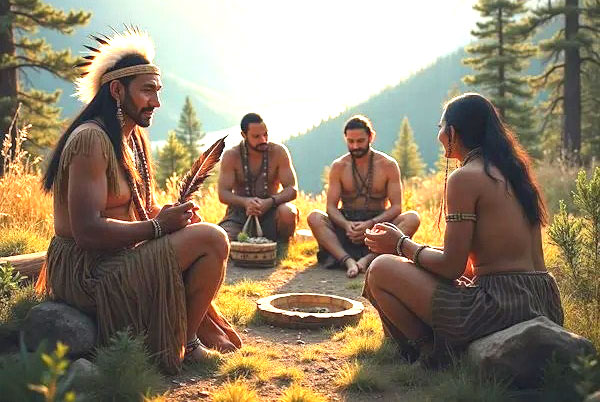
Spiritual leadership in Native American communities is held by shamans, medicine men/women, elders, and spiritual leaders, known by different titles across tribes. Their roles include:
• Performing healing rituals
• Guiding vision quests and initiations
• Communicating with spirits and ancestors
• Preserving oral histories and sacred knowledge
Among the Plains tribes, the Holy Man or Medicine Man conducts sacred pipe ceremonies and healing dances. In Pueblo cultures, religious leaders guide kiva ceremonies and seasonal rituals in subterranean chambers.
Sacred Places and Symbols
Nature is the most important sacred text in Native American religions. Places like mountains, rivers, rocks, and forests are imbued with spiritual power.
Some key sacred places include:
| Sacred Site |
Tribe / Location |
Significance |
| Bear Butte |
Lakota (South Dakota) |
Site of vision quests and pilgrimage |
| Black Hills |
Lakota (South Dakota) |
Considered the “Heart of Everything That Is” |
| Mount Shasta |
Wintu (California) |
Portal to the spirit world |
| Canyon de Chelly |
Navajo (Arizona) |
Site of ancestral presence and ceremonies |
Symbols such as the medicine wheel, eagle feather, sacred pipe, drum, and dreamcatcher carry powerful spiritual meanings related to balance, protection, and connection to the divine.
Rituals and Ceremonies
Native American religious life is built around rituals that reflect nature’s cycles and life’s milestones. These rituals are often communal and deeply symbolic :
• Vision Quests : Solitary fasting in nature to seek spiritual guidance.
• Sun Dance : A communal renewal ceremony involving fasting, dancing, and piercing (Plains tribes).
• Sweat Lodge : A purification ritual involving steam and prayer inside an enclosed hut.
• Naming and Coming-of-Age Ceremonies : Marking spiritual and personal development.
• Healing Ceremonies : Using chants, herbs, and sand paintings (notably among Navajo).
Each tribe has unique variations, yet the goal is consistent: restoring balance between body, spirit, nature, and community.
Festivals and Sacred Calendars
Native American festivals are often tied to seasonal changes, harvests, and tribal myths. Examples include :
| Festival |
Tribe |
Purpose |
| 1. Green Corn |
Southeastern |
Marks corn harvest and spiritual renewal |
| 2. Ceremony |
Tribes |
| 3. Powwow |
Pan-Tribal |
Celebration of community with dance, music, and storytelling |
| 4. Hopi Soyaluna |
Hopi |
Winter solstice festival calling for the sun’s return |
| 5. Navajo Night Chant |
Navajo |
9-day healing ceremony involving complex rituals |
Dances, songs, and costumes are not entertainment but sacred acts of storytelling, prayer, and honoring the spirits.
Philosophy and Ethics
Native American spirituality is non-dogmatic but deeply ethical. Core values include :
• Respect for Nature : Animals, plants, rivers, and winds are relatives, not resources.
• Reciprocity : Give back to the Earth what is taken.
• Harmony : Inner peace must align with the outer world.
• Respect for Elders and Ancestors : Wisdom flows from past generations.
The "Seventh Generation Principle" found in Iroquois belief teaches that every action should consider its impact on seven future generations.
Number of Followers and Distribution
Estimating exact numbers is difficult due to :
• Overlaps with Christianity (syncretism)
• Private practice due to historical suppression
• Tribal sovereignty over religious categorization
However, estimates suggest :
• Over 4 million Native Americans in the U.S. and 1.5 million in Canada
• At least 25-30% actively practice Native spiritual traditions
• Many more participate in cultural-spiritual events like Powwows
Moreover, Native religions have influenced global spiritual movements, especially in ecology, holistic healing, and interfaith dialogue.
Contemporary Challenges and Revivals
Native American religions have endured centuries of persecution, including :
• Forced Christianization
• Outlawing of ceremonies (Sun Dance was illegal until 1978 in the U.S.)
• Boarding schools erasing native culture
However, in recent decades there has been a revival of Native spiritual identity :
• The American Indian Religious Freedom Act (1978) protected traditional practices.
• Young Native Americans are reclaiming language, rituals, and ceremonies.
• Intertribal efforts have preserved sacred sites and passed knowledge to new generations.
Contributions to Humanity
• Environmental Stewardship : Inspiring ecological ethics rooted in kinship with Earth.
• Holistic Medicine : Herbal and spiritual healing with growing interest worldwide.
• Peace and Conflict Resolution : Circle councils, restorative justice models.
• Art, Song, and Dance : Rich cultural heritage inspiring global appreciation.
Conclusion
Native American religions are not only spiritual paths but lifeways that bind people to the land, ancestors, and each other. They remind us of the sacredness in nature, the wisdom of silence, and the power of prayer woven into every breath of life. In an age of disconnection and climate crisis, these indigenous traditions offer a vision of harmony that is both ancient and urgently modern.
-----------------------------------------------------
Author : CA A. K. Jain
Cell : +91 98 100 46108
-----------------------------------------------------
Mail to : Ahimsa Foundation
www.jainsamaj.org
R24052025