Australian Aboriginal Beliefs
By CA A. K. Jain
Introduction
Among the oldest continuing cultures on Earth, the Australian Aboriginal peoples possess a rich and deeply spiritual worldview known broadly as Aboriginal Beliefs or Aboriginal Spirituality. Rooted in what they call the Dreamtime (or Dreaming), this spiritual system is not merely a religion but a total cosmology-explaining the creation of the world, the moral order of society, the role of humans within nature, and the sacred relationship between people and the land.Even in the modern era, many Aboriginal communities in Australia continue to practice and pass down these beliefs, blending ancient customs with the realities of contemporary life.
Origins and the Dreamtime
Unlike conventional religions with a singular founder or holy book, Aboriginal spirituality has no fixed beginning, because Dreamtime exists outside linear time. It is the primordial era of creation, when ancestral spirits emerged from the Earth and formed landscapes, rivers, animals, plants, and humans.
These ancestors-known by names such as the Rainbow Serpent, Baiame, or Daramulan-left songlines (or dreaming tracks) across the land, which are sacred maps embedded in geography, stories, and rituals.
Each Aboriginal nation or clan group has its own Dreaming stories, but they are connected through a shared belief in the unity of land, law, and life.
Philosophy and Core Beliefs
Aboriginal spirituality is holistic, land-based, and ancestrally connected. Its central tenets include :
• The Land is Sacred : Not just property, but a living being. Every mountain, rock, waterhole, and tree may hold a spirit or ancestral presence.
• Ancestral Beings Still Exist : They are not dead but continue to shape life through rituals, dreams, and signs.
• Songlines : Spiritual pathways that link sacred places, stories, and the journey of creation beings. They guide navigation, law, and ethics.
• Kinship and Totems : Every person belongs to a clan or skin group, with responsibilities to protect animals, landforms, and elements associated with their totems.
This belief system shapes moral behavior, identity, and social cohesion.
Spiritual Teachers and Elders
There are no centralized priests in Aboriginal spirituality. Instead, spiritual authority lies with elders, who are the custodians of:
• Dreaming stories
• Sacred rituals
• Land lore
• Cultural law
Elders often acquire spiritual authority through initiation, wisdom, and community trust. In many communities, men and women have distinct spiritual roles, and some sacred knowledge is gender-specific.
Sacred Places and Symbols
The Aboriginal worldview is deeply geographical. Sacred sites across Australia are revered not for architectural grandeur but for their spiritual history.
|
Sacred Place
|
People
|
Significance
|
|
Uluru (Ayers Rock)
|
Anangu
|
Central to multiple Dreamtime stories; site of initiation and ceremony
|
|
Kata Tjuta (The Olgas)
|
Pitjantjatjara
|
Home of ancestral spirits; linked to Tjukurpa (Dreaming law)
|
|
Birrarung (Yarra River)
|
Wurundjeri
|
Spiritual waterway and lifeline for the people
|
|
Gariwerd (Grampians)
|
Djab Wurrung
|
Sacred rock art and creation stories
|
Symbols like dots, animal tracks, concentric circles, and lines appear in art and body painting to express Dreaming and ceremony.
Rituals and Ceremonies
Rituals serve to connect the present with the Dreaming, maintain social laws, and honor the spirits.
Key ceremonies include :
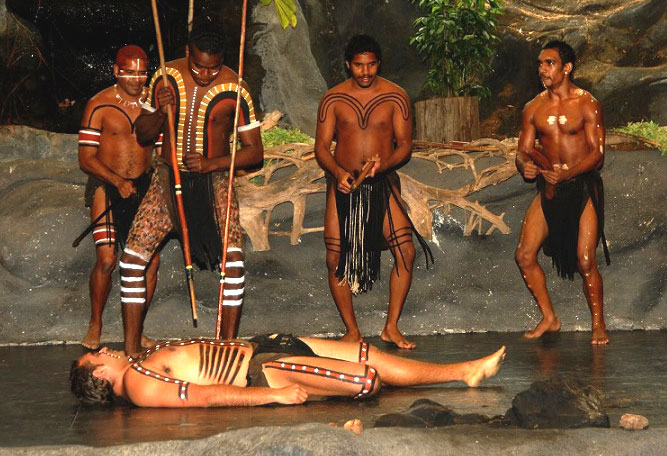
• Corroborees : Public dances, songs, and storytelling performed at night to share Dreaming stories.
• Initiation Ceremonies : Complex rites for boys and girls transitioning to adulthood. May involve scarification, storytelling, and learning sacred knowledge.
• Smoking Ceremonies : Used to cleanse people and places of bad spirits, often performed at births, deaths, and gatherings.
• Burial Rites : Honoring the dead through mourning songs, paintings, and sometimes bone ceremonies, to guide the spirit to the Dreaming.
Festivals and Cultural Events
While many ceremonies are private, several cultural events showcase Aboriginal spirituality :
|
Festival
|
Location
|
Description
|
|
Garma Festival
|
Arnhem Land, NT
|
Celebrates Yolngu culture with music, art, and storytelling
|
|
Laura Aboriginal Dance Festival
|
Queensland
|
Traditional dance and culture from Cape York Peninsula communities
|
|
Yabun Festival
|
Sydney
|
Largest national gathering on Australia Day celebrating Aboriginal culture & resistance
|
These festivals serve not only spiritual purposes but also reclaim cultural identity and educate younger generations.
Followers and Distribution
There are approximately 800,000 Aboriginal and Torres Strait Islander people in Australia (2021 Census), representing about 3.2% of the national population. Among them:
• A significant number continue to follow or integrate traditional beliefs.
• Many combine Aboriginal spirituality with Christianity (due to missionary influence), resulting in syncretic practices.
• Aboriginal spirituality is also respected by non-Indigenous Australians, particularly environmentalists and scholars.
Contemporary Challenges and Revival
Despite its ancient roots, Aboriginal spirituality has faced colonial disruption, including :
• Stolen Generations : Children removed from families and disconnected from spiritual teachings.
• Destruction of sacred sites by mining and development.
• Legal and land disputes over Dreaming paths and ancestral territories.
However, recent decades have seen a spiritual resurgence :
• Land rights and native title recognitions
• Cultural education in schools
• Revival of language and ceremony
• Public smoking ceremonies and Welcome to Country rituals
Efforts like the Uluru Statement from the Heart (2017) also reflect a spiritual reclaiming of voice and law.
Contributions to Humanity
• Ecological ethics : “Caring for Country” as a spiritual duty.
• Oral history : Preserving ancient narratives now validated by science.
• Conflict resolution : Customary law and spiritual justice.
• Art and music : Globally respected expressions rooted in spiritual Dreaming.
Conclusion
Australian Aboriginal Beliefs offer a sacred worldview where every rock, tree, and star carries memory, meaning, and moral law. In a world facing environmental crisis and spiritual fragmentation, Aboriginal spirituality provides a profound model of living in balance with nature, honoring ancestors, and walking gently on the land.These are not just traditions of the past but voices of deep wisdom still echoing across the ancient lands of Australia.
-----------------------------------------------------
Author : CA A. K. Jain
Cell : +91 98 100 46108
-----------------------------------------------------
Mail to : Ahimsa Foundation
www.jainsamaj.org
R24052025