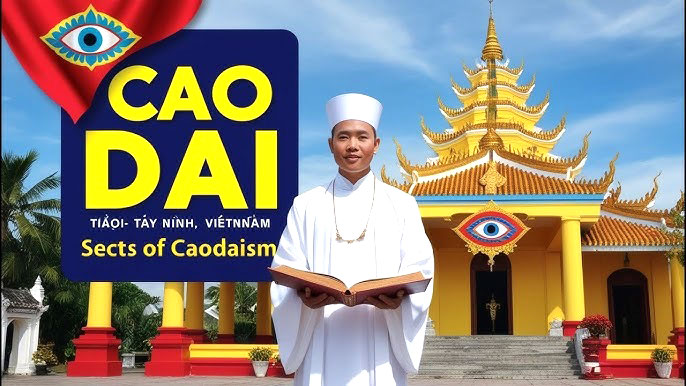
Cao Dai - A Syncretic Vietnamese Religion
By CA A. K. Jain
Origin
• Founded : In 1926, Tây Ninh Province, southern Vietnam.
• Full name : ĐạiĐạo Tam KỳPhổĐộ - The Great Faith [for] the Third Universal Redemption.
• Founder : Ngô Văn Chiêu, a former colonial civil servant, and other Vietnamese intellectuals.
• Divine Revelation: Caodaiists believe that God (referred to as Đức Cao Đài or The Highest Lord) communicated with them through spiritist séances.
• Purpose : To unify all religions and create a universal truth that brings harmony and peace.
Geographical Spread and Followers
| Country / Region |
Approx. Followers (2024) |
Notes |
| Vietnam |
~6 to 8 million |
Predominantly in the South, especially Tây Ninh. |
| Cambodia |
~20,000 |
Migrant Vietnamese community. |
| United States |
~10,000–15,000 |
Vietnamese diaspora in California and Texas. |
| Australia, Canada, France |
~5,000+ combined |
Small but active communities. |
Philosophy and Beliefs
Cao Dai incorporates elements of Confucianism, Taoism, Buddhism, Christianity, and Islam, as well as traditional Vietnamese animism and spiritism.
Core Tenets:
• Belief in one supreme God.
• Veneration of the divine spirits of historical figures such as:
o Jesus Christ
o Buddha (Sakyamuni)
o Laozi
o Confucius
o Muhammad
o Victor Hugo (yes, the French writer, revered as a spiritual figure)
o Sun Yat-sen
o Joan of Arc
• Practice of ethical living, vegetarianism, and spiritual growth through prayer and meditation.
Important Personalities
| Name |
Contribution |
| Ngô Văn Chiêu |
First disciple to receive divine messages; revered as the first "ĐạoSư" (religious master). |
| Lê Văn Trung |
Appointed the first Pope (GiáoTông) of Caodaism in 1926. |
| Phạm Công Tắc |
Key theologian and spiritual leader, contributed to organizational expansion and scriptures. |
| Victor Hugo (posthumously) |
Believed to have spiritually communicated with early followers. Seen as a Saint. |
Important Events in History
• 1926 : Founding ceremony in Tây Ninh - over 247 signatories from across southern Vietnam.
• 1930s–1940s : Rapid expansion in southern Vietnam. Establishment of religious hierarchy and institutions.
• 1955–1975 : Played political roles in South Vietnam; the Tây Ninh Holy See was a stronghold.
• Post-1975 : After the Vietnam War, activities were restricted under Communist rule but revived gradually.
• 1997 : Official recognition by the Vietnamese government.
Places of Worship and Symbols
• Holy See (Tòa Thánh Tây Ninh) : Headquarters of the Cao Dai religion, an architectural marvel in Tây Ninh.
• The Divine Eye (Thiên Nhãn) : A left eye inside a triangle-symbol of God watching over humanity.
Festivals and Rituals
| Festival |
Date (Lunar Calendar) |
Significance |
| Đức Cao Đài’s Birthday |
9th of the 1st lunar month |
Birthday of God the Father. |
| Founding Day (Establishment Day) |
15th of the 10th lunar month |
Anniversary of the religion’s founding in 1926. |
| All Souls’ Day |
15th of the 7th lunar month |
Honoring ancestors and the dead. |
| Mid-Autumn Festival |
15th of the 8th lunar month |
Celebrated with lanterns and rituals for children. |
Diaspora and International Reach
• Caodai temples have been established in :
o California (USA) - Garden Grove, San Jose, and Houston.
o Paris (France) - spiritual center for European followers.
o Australia and Canada - small congregations in major cities.
• The religion has temples, associations, and charity bodies active in welfare and spiritual training.
Contribution to Humanity and Community
• Interfaith Harmony : Promotes peace and mutual understanding among world religions.
• Education and Charity : Operates schools, clinics, and orphanages in Vietnam.
• Spiritual Ecology : Encourages vegetarianism and moral living.
• Cultural Diplomacy : Maintains relations with the UN and NGOs for interfaith cooperation.
Tabular Summary
| Aspect |
Details |
| Founded |
1926, Vietnam |
| Founders |
Ngô Văn Chiêu, Lê Văn Trung, others |
| Headquarters |
Tây Ninh, Vietnam |
| Estimated Global Followers |
~6.5–8.5 million |
| Deity |
One Supreme God (Cao Đài) |
| Sacred Symbol |
The Divine Eye |
| Main Beliefs |
Unity of religions, reincarnation, karma, ethical life |
| Religious Texts |
Pháp Chánh Truyền, Tân Luật, and divine messages |
| Clergy Structure |
Hierarchical, similar to the Catholic Church with Popes, Cardinals, etc. |
| Major Festivals |
Founding Day, God’s Birthday, All Souls’ Day |
| Key Contributions |
Religious syncretism, peacebuilding, social service |
Current Trends and Future Outlook
• Increasing recognition by the Vietnamese government and international religious bodies.
• Growth of temples and followers in diaspora communities.
• Digital outreach is spreading awareness among the younger Vietnamese generation.
• Potential role in interreligious dialogue, given its inclusive and pluralistic philosophy.
-----------------------------------------------------
Author : CA A. K. Jain
Cell : +91 98 100 46108
-----------------------------------------------------
Mail to : Ahimsa Foundation
www.jainsamaj.org
R23052025