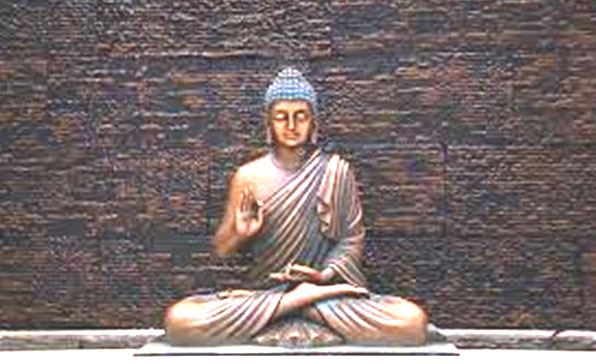
Lord Buddha and the Inception of Buddhism
By CA A. K. Jain
The Birth of Siddhartha Gautama
Around the 6th century BCE, in the foothills of the Himalayas in Lumbini (present-day Nepal), a child was born to King Suddhodana and Queen Maya of the Shakya clan. This child, Siddhartha Gautama, was destined for greatness. Astrologers foretold that he would become either a great king or a spiritual leader. His father, hoping Siddhartha would become a ruler, shielded him from all forms of suffering.
The Four Sights and the Great Renunciation
Despite the palace luxuries, Siddhartha grew curious about life outside the royal walls. At the age of 29, he ventured out and witnessed the Four Sights:
1. An old man (age),
2. A sick person (disease),
3. A corpse (death),
4. A wandering ascetic (spiritual seeker).
These sights shook Siddhartha deeply. He realized the impermanence of life and the universal nature of suffering. He left his palace, wife, and newborn son in what is known as the Great Renunciation to seek the truth about life and liberation.
The Path to Enlightenment
For six years, Siddhartha practiced severe austerities with hermits but found no lasting peace. He then sat in deep meditation under the Bodhi Tree in Bodh Gaya (India), vowing not to rise until he attained the truth.
On the 49th day, he achieved Enlightenment (Bodhi). He became the Buddha-the Awakened One.
The First Sermon and Spread of Buddhism
Soon after his enlightenment, Lord Buddha gave his first sermon at Sarnath to his five former companions, known as the Dhammacakkappavattana Sutta (Turning the Wheel of Dharma), teaching the Four Noble Truths and the Eightfold Path.
Four Noble Truths :
1. Life involves suffering (Dukkha).
2. Suffering is caused by desire (Tanha).
3. There is a cessation of suffering (Nirvana).
4. The path to the cessation is the Eightfold Path.
The Buddha wandered for 45 years, teaching people from all castes and genders, forming a community called the Sangha.
Buddhism in the Modern World
Global Presence
Buddhism has evolved into multiple schools, the major ones being :
| School |
Region |
Characteristics |
| Theravāda |
Sri Lanka, Thailand, Myanmar, Cambodia, Laos |
Oldest school, emphasizes individual liberation |
| Mahāyāna |
China, Korea, Japan, Vietnam |
Emphasizes Bodhisattva path for all beings |
| Vajrayāna |
Tibet, Mongolia, Bhutan |
Tantric practices, rituals, and mantras |
Countries with Significant Buddhist Population
| Country |
% Population (Approx.) |
Notes |
| Thailand |
93% |
State-supported Theravāda Buddhism |
| Cambodia |
97% |
Deeply integrated with national culture |
| Myanmar |
88% |
Strong monastic tradition |
| Bhutan |
75% |
Vajrayāna is the state religion |
| Sri Lanka |
70% |
Center of Theravāda scholarship |
| Japan |
69% |
Mostly Mahāyāna, many syncretic forms |
| China |
18% |
Home to Zen and Pure Land traditions |
| South Korea |
15% |
Mahāyāna and Seon (Zen) traditions |
| Nepal |
9% |
Buddha’s birthplace, mixed traditions |
| India |
0.7% |
Revival by Dr. B. R. Ambedkar |
Total global Buddhists : Estimated at over 500 million (approx. 6.5% of world population)
Contribution of Buddhism to World Peace
1. Philosophy of Non-violence (Ahimsa)
Buddhism preaches non-harming of all sentient beings. Its followers practice compassion (Karuna) and loving-kindness (Metta), forming a moral foundation for peace and coexistence.
2. Mindfulness and Meditation
Buddhist practices like Vipassanā and Zen meditation promote self-awareness, mental peace, and emotional control, aiding personal and societal harmony. Mindfulness is now widely applied in therapy, education, and conflict resolution worldwide.
3. Interfaith Harmony
Buddhist leaders, including the Dalai Lama, have been global ambassadors of interfaith dialogue, promoting religious tolerance and unity.
4. Nonviolent Movements
Buddhism has inspired peaceful resistance:
• Dr. B. R. Ambedkar’s Dalit movement in India based on Buddhist values.
• Thich Nhat Hanh's nonviolent activism during the Vietnam War.
• The Dalai Lama's advocacy for Tibet through peace and dialogue.
5. Ecological Awareness
Buddhist teachings emphasize respect for nature and simplicity, encouraging sustainable living and ecological balance.
Conclusion
Lord Buddha’s teachings, born out of a quest to understand suffering, have traveled through millennia to become a global moral compass. With no dependence on a creator god, Buddhism’s practical and ethical approach to life resonates deeply in today’s world, torn by conflict, stress, and ecological crises. Buddhism offers peace through inner transformation, proving that when the mind is calm, the world too can be a better place.
-----------------------------------------------------
Author : CA A. K. Jain
Cell : +91 98 100 46108
-----------------------------------------------------
Mail to : Ahimsa Foundation
www.jainsamaj.org
R12052025