


A Foundation Day Message for Mahavir International
VIR CA Anil K Jain
Zone Vice-Chairman & Co-Director of Water Conservation
Water: The Foundation of Life
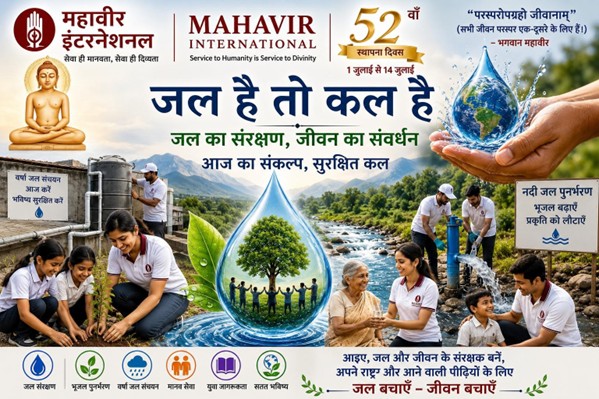
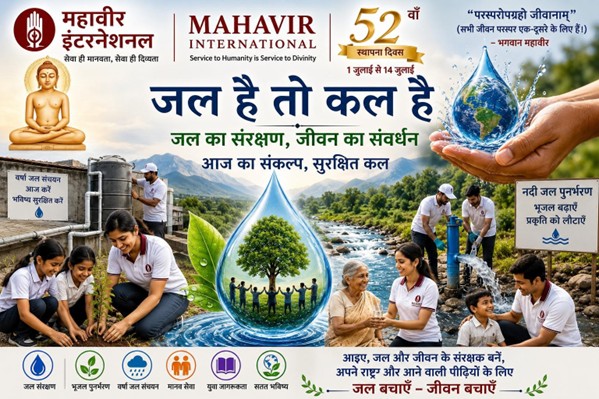
As Mahavir International celebrates its 52nd Foundation Day, it is appropriate to reflect upon one of the most important issues facing humanity today—water. The timeless Jain principle of "Parasparopagraho Jivanam" reminds us that all life is interconnected and mutually dependent. Nothing demonstrates this interdependence more clearly than water, the very foundation of human life, agriculture, industry, ecology, and economic development.
The Reality Behind the Blue Planet
Although the Earth is known as the "Blue Planet," nearly 97% of its water is saline. Of the small fraction that is fresh, much is locked in glaciers and ice caps. The water available for human use is limited and is increasingly threatened by population growth, urbanisation, pollution, climate change, and excessive
Groundwater extraction. Consequently, water scarcity has emerged as one of the defining challenges of the twenty-first century.
India's Great Water Paradox
India presents a striking paradox. The country is blessed with mighty rivers such as the Ganga, Brahmaputra, Yamuna, Narmada, Godavari, Krishna, Mahanadi, and many others, yet millions of people continue to face water shortages. During summer, villages depend on water tankers, cities struggle with declining reservoirs, and farmers often extract water from depths of 500 to 600 feet at enormous cost. The challenge before India is therefore not merely the availability of water, but its scientific management, conservation, storage, recharge, and efficient utilisation.
Government Efforts and National Initiatives
Governments at both the Central and State levels have undertaken significant initiatives, including the Jal Jeevan Mission, Atal Bhujal Yojana, Namami Gange Programme, watershed development projects, and rainwater harvesting campaigns. These programmes have contributed substantially to improving water access and awareness. Nevertheless, groundwater depletion, pollution, inefficient water use, and dependence on monsoon rainfall continue to pose serious challenges.
Learning from Global Success Stories
The experience of several countries demonstrates that water scarcity can be successfully addressed through innovation, planning, and public participation. Israel, despite limited rainfall, has become a global leader in water security through drip irrigation, wastewater recycling, desalination, and groundwater recharge. Singapore, with virtually no significant natural freshwater resources, has achieved remarkable water self-reliance through rainwater harvesting, advanced recycling technologies, and desalination. Australia has strengthened its resilience through integrated river basin management, efficient irrigation systems, and groundwater recharge programmes.
The Lesson from South Africa
South Africa's Cape Town water crisis, popularly known as the "Day Zero" crisis, showed that even modern cities can face severe water shortages. However, through strict conservation measures, public participation, transparent governance, and efficient water management, the city successfully avoided disaster. This example demonstrates that water scarcity is often not simply a problem of nature, but a challenge of management and governance.
Groundwater: Nature's Hidden Reservoir
Increasingly, experts around the world are recognising the importance of groundwater recharge. Groundwater aquifers constitute vast underground
reservoirs that can store enormous quantities of freshwater with minimal evaporation losses. Many countries are investing in managed aquifer recharge programmes to replenish depleted groundwater reserves and improve long-term water security.
River Water Recharge: A Strategic Opportunity
In this context, the concept of River Water Recharge deserves serious consideration. India's rivers carry enormous quantities of freshwater across thousands of kilometres before ultimately reaching the Arabian Sea and the Bay of Bengal. While river flows are essential for ecological balance, there may be significant opportunities to scientifically recharge depleted aquifers during periods of surplus flow through specially designed recharge wells, infiltration galleries, recharge basins, and riverbank filtration systems.
International Experience in Aquifer Recharge
Similar approaches have been adopted in various forms in countries across Europe, North America, Australia, and Israel. Managed Aquifer Recharge systems have demonstrated that underground storage can become an effective complement to traditional reservoirs. If scientifically designed and implemented, river water recharge could contribute significantly to raising groundwater levels, reducing dependence on deep bore wells, strengthening drought resilience, and enhancing long-term water security.
Why Community Participation Matters
The challenge of water conservation cannot be left to governments alone. Social and community organizations have a vital role to play. Sustainable water security can only be achieved when citizens actively participate in conservation, recharge, and responsible water use.
The Role of Mahavir International
Mahavir International, with its extensive network of chapters across the country, is uniquely positioned to become a catalyst for water awareness and action. The organisation can promote water literacy, support rainwater harvesting and groundwater recharge projects, restore traditional water bodies, organise awareness campaigns, and encourage community participation.
From Awareness to Action
Local chapters can establish practical demonstration projects at schools, community centres, and public institutions. Even modest rainwater harvesting and recharge systems can return hundreds of thousands of litres of water to the ground each year. Through such initiatives, Mahavir International can help foster a culture of Jal Sanskar—water stewardship and responsible water use.
Water and Future Generations
The future of humanity will depend not only on technological advancement but also on the wise management of natural resources. Water is not merely an environmental concern; it is an economic, social, public health, and national security issue. Countries around the world have demonstrated that water crises can be substantially reduced through science, innovation, public participation, and responsible governance.
A Foundation Day Pledge
As Mahavir International celebrates its 52nd Foundation Day, let us renew our commitment to protecting one of nature's most precious gifts. Let every member become a guardian of water conservation, every chapter a centre of awareness, and every community a partner in sustainability.
Conclusion: Water is Life
Water is not merely a resource; it is the basis of life itself. The choices we make today will determine the quality of life available to future generations. Let us therefore embrace water conservation as both a civic responsibility and a moral duty.
Water is life.
Water is prosperity.
Water is a responsibility.
-----------------------------------------------
VIR CA Anil K Jain
Zone Vice-Chairman & Co-Director of Water Conservation Cell: +919810046108, Mail: caindia@hotmail.com
Ahimsa Foundation warmly welcomes information, photographs, literature, articles, and other meaningful contributions for publication on this web portal: www.jainsamaj.org | ✉ CAINDIA@HOTMAIL.COM
We also invite advertisements and sponsorship support to help us expand the reach of this social initiative and promote public awareness of Jain ideology.
 Related
 Related
 Related

Copyright © 2026 jainsamaj. All rights reserved.