


Jain Chaturmas and Paryushan:
A Comprehensive Perspective Across Jain Traditions
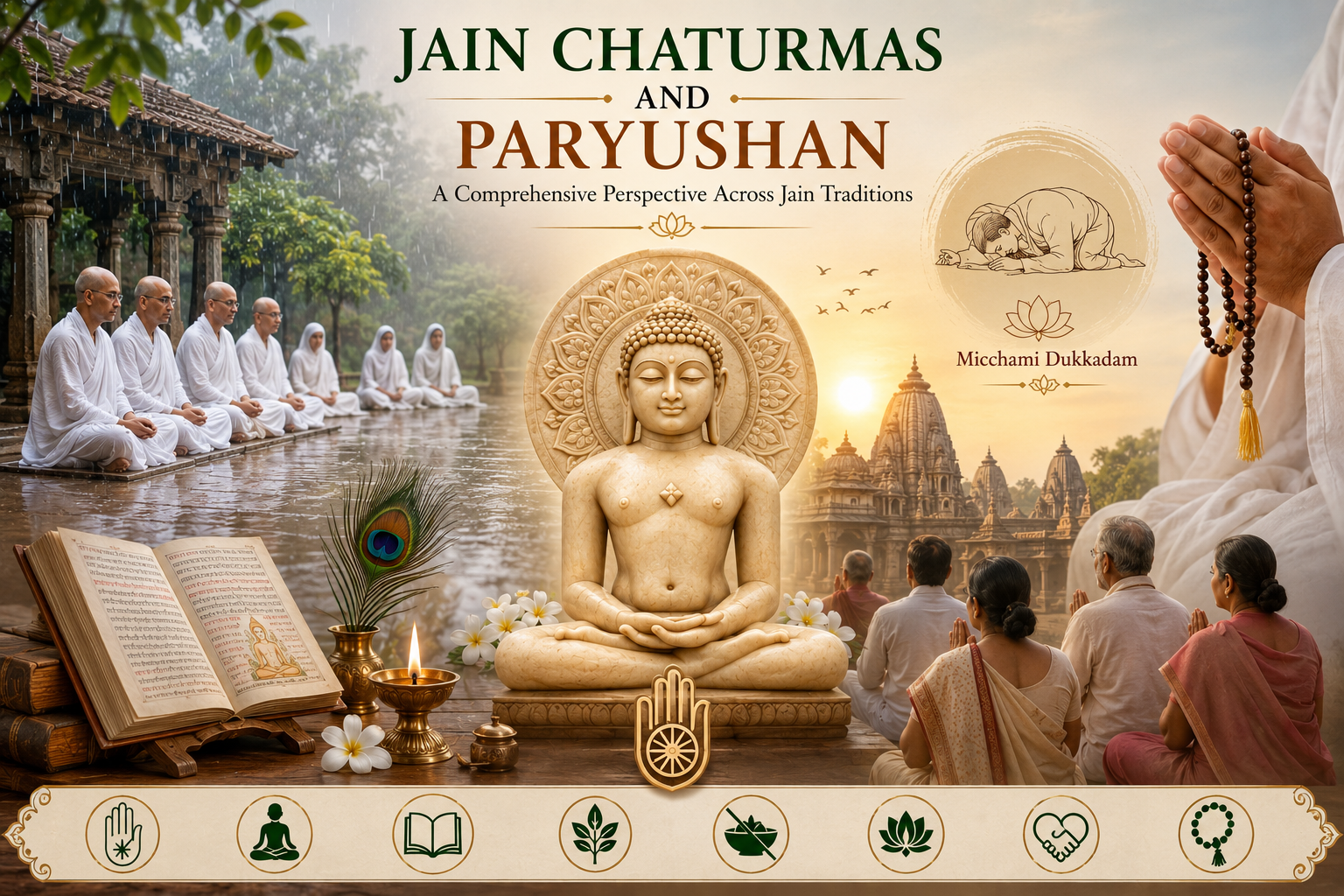
By Anil K Jain,
Ahimsa Foundation India
Mail:caindia@hotmail.com
Introduction
Jainism is a religion of
Ahimsa (non-violence), self-discipline, austerity, non-attachment, forgiveness
and purification of the soul. Its religious observances are therefore less
about outward celebration and more about inner transformation. Among the most
sacred periods in the Jain calendar are Chaturmas, Paryushan Mahaparva in the
Shvetambara traditions, and Das Lakshan Mahaparva in the Digambara tradition.
Although practices vary among
Shvetambara Murtipujak, Sthanakvasi, Terapanthi, Digambara and other Jain
traditions, their essential purpose is shared: restraint of passions, reduction
of karmic bondage, cultivation of virtues and progress towards
Moksha—liberation of the soul.
Jain
Chaturmas: The Sacred Monsoon Retreat
The word Chaturmas literally
means "four months." It broadly corresponds with the Indian monsoon
season, when Jain monks and nuns, who ordinarily travel from place to place on
foot, remain principally in one location. This rainy-season residence is also
associated with Varshavas or Varshayog.
The practice is deeply rooted
in Ahimsa. During the monsoon, vegetation flourishes and insects and
innumerable minute living organisms multiply. Extensive movement during this
period may cause unintended injury to such life. Jain ascetics therefore restrict
their movement as an expression of exceptional care towards living beings. Chaturmas
consequently represents much more than a restriction on travel. It expresses an
important Jain principle: human convenience must yield before reverence for
life.
Chaturmas as
a Period of Spiritual Awakening
The residence of monks and
nuns in one place creates an important opportunity for interaction between the
ascetic and lay communities. During Chaturmas, religious activities intensify
through Pravachan (discourses), Swadhyaya (scriptural study), Samayik
(equanimity), Pratikraman (introspection and repentance), Tap (austerity), Tyag
(renunciation), meditation and Dharma-charcha.
For householders, Chaturmas is
an opportunity to voluntarily reduce worldly indulgence. Many undertake
additional vows concerning food, consumption, entertainment, travel and daily
spiritual practices. Thus, Chaturmas becomes a kind of annual spiritual
university, in which monks, nuns, householders, children and youth participate
according to their capacity.
Chaturmas
Across Jain Sects
In the Shvetambara Murtipujak
tradition, Chaturmas generally includes religious discourses, scriptural study,
temple worship, Samayik, Pratikraman and various austerities, with Paryushan
becoming its major spiritual culmination.
The Sthanakvasi tradition,
which does not practise image worship, gives particular importance to Samayik,
Pratikraman, meditation, fasting, scriptural discourses and internal
purification.
The Terapanth tradition
similarly emphasizes disciplined monastic life, meditation, Swadhyaya,
austerity, ethical conduct and spiritual guidance under its organised ascetic
tradition.
In the Digambara tradition,
the rainy-season retreat is likewise important for monks and other ascetics.
Lay followers intensify worship, study, fasting, meditation and restraint, with
Das Lakshan Mahaparva becoming one of the principal spiritual observances of
the season.
The external practices may
differ, but Ahimsa, Samyam, Tap and Atma-shuddhi—purification of the soul—remain
common foundations.
Paryushan
Mahaparva
Paryushan is among the holiest
observances of Jainism, especially in the Shvetambara traditions. It is
generally observed for eight days, culminating in Samvatsari. Paryushan
represents turning away from excessive external activity and returning towards
one's true spiritual nature. It invites the individual to examine: Whom have I
hurt? What mistakes have I committed? What passions govern me? Whom should I
forgive? From whom should I seek forgiveness?
During Paryushan, devotees
intensify fasting, Samayik, Pratikraman, Swadhyaya, meditation, Pravachan,
charity, renunciation and self-examination. The real purpose is the reduction
of the four principal Kashayas—Krodha (anger), Mana (pride), Maya (deceit) and
Lobha (greed).
Kalpa Sutra
and Scriptural Study
In many Shvetambara
traditions, particularly the Murtipujak tradition, the Kalpa Sutra occupies an
important place during Paryushan. It contains accounts concerning the
Tirthankaras, especially Bhagwan Mahavira, together with material relating to
Jain monastic traditions and discipline. Its ceremonial reading and explanation
make Paryushan an important period of religious education. Jainism, however,
emphasizes that knowledge must ultimately transform conduct. Swadhyaya is
therefore not simply intellectual study but a means of self-purification.
Tapasya:
Fasting and Austerity
Tap, or austerity, is one of
the most visible features of Paryushan. Jains may undertake different forms of
fasting and dietary restraint according to individual capacity, health,
tradition and religious guidance.
However, fasting is a means
rather than the final objective. An impressive fast accompanied by anger, pride
or ego defeats its deeper spiritual purpose. True Tap seeks to control desires
and weaken passions. In this sense, Jain austerity is not simply about giving
up food; it is about giving up anger, ego, deceit, greed and attachment.
Samayik and
Pratikraman
Samayik is the disciplined
practice of equanimity. For a prescribed period, the individual attempts to
withdraw from worldly attachments and cultivate equality towards all living
beings.
Pratikraman is one of
Jainism's most profound practices of ethical self-accountability. It involves
looking back upon one's actions, acknowledging faults, repenting for harmful
conduct and resolving to exercise greater care in future. A sincere Pratikraman
asks whether one has caused injury through thought, speech or action; spoken
harshly; acted dishonestly; allowed greed or ego to govern conduct; or failed
in compassion.
It can therefore appropriately
be described as a spiritual and ethical audit of oneself.
Samvatsari
and Micchami Dukkadam
The final day of Shvetambara
Paryushan is Samvatsari, the great annual occasion of introspection and
forgiveness. After the special annual Pratikraman, Jains seek forgiveness for
offences committed knowingly or unknowingly. The celebrated expression
"Micchami Dukkadam" embodies this spirit: if I have caused you pain
through my thoughts, words or actions, knowingly or unknowingly, may those
wrongs become fruitless and please forgive me.
Its wider spiritual sentiment
is beautifully expressed:
I forgive all living beings.
May all living beings forgive me. I have friendship towards all and enmity
towards none. Forgiveness in Jainism is therefore not merely social courtesy;
it is a method of overcoming anger, ego, hatred and karmic bondage.
Digambara
Das Lakshan Mahaparva
The Digambara tradition
observes the spiritually related Das Lakshan Mahaparva, generally for ten days.
Each day emphasizes one of the ten supreme virtues (Uttam Dharma):
Uttam Kshama – Supreme
Forgiveness; Uttam Mardava – Supreme Humility; Uttam Arjava – Supreme
Straightforwardness; Uttam Shaucha – Supreme Purity/Contentment; Uttam Satya –
Supreme Truth; Uttam Samyam – Supreme Self-restraint; Uttam Tap – Supreme
Austerity; Uttam Tyaga – Supreme Renunciation; Uttam Akinchanya – Supreme
Non-possessiveness; and Uttam Brahmacharya – Supreme Chastity.
These ten virtues constitute a
systematic programme for transforming human character. Kshamavani, associated
with the conclusion of this sacred period, gives special importance to seeking
and granting forgiveness.
Thus, both Samvatsari and
Kshamavani convey the powerful Jain message that spiritual advancement requires
freedom from resentment and hostility.
Unity Among
Different Jain Traditions
Jainism has diverse sects and
sub-traditions. Some practise image worship while others do not; scriptures,
rituals, calendars and forms of worship may also differ. Yet beneath this
diversity lies extraordinary philosophical unity. The principal traditions
share commitment to Ahimsa, Satya, Asteya, Brahmacharya, Aparigraha, Samyam,
Tap, Swadhyaya, Kshama and purification of the soul.
The Jain doctrine of
**Anekantavada—the many-sided nature of reality—**itself provides a
philosophical basis for respecting diversity of viewpoints and practices. Different
traditions may therefore follow different external forms while moving towards
the common objective of overcoming attachment and aversion and achieving
spiritual purification.
Chaturmas,
Paryushan and the Jain Theory of Karma
The deeper significance of
these observances becomes clear through the Jain doctrine of Karma. Passions
such as anger, pride, deceit and greed contribute to karmic bondage. Jain
spiritual discipline therefore seeks Samvara, the prevention or checking of new
karmic influx, and Nirjara, the shedding of accumulated karma. Ahimsa,
restraint, meditation, fasting, repentance, forgiveness and non-attachment are
therefore not isolated rituals. They form part of a comprehensive spiritual
path leading ultimately towards Moksha.
Aparigraha
and Environmental Responsibility
The message of Chaturmas has
remarkable contemporary relevance. By restricting movement during a season
abundant with life, Jain ascetics demonstrate that humans must adjust their
behaviour out of consideration for other living beings. This principle can be
extended to modern concerns such as biodiversity, animal welfare, food ethics,
water conservation, environmental protection, responsible consumption and
reduction of waste.
Similarly,
**Aparigraha—non-possessiveness—**challenges modern consumerism. Instead of
continually asking, "What more can I acquire?" Jain philosophy asks,
"How much do I actually need?"The Jain ideal of sustainability
therefore begins not merely with recycling resources but with reducing
unnecessary desire and consumption.
Relevance to
Modern Life
Paryushan offers a powerful
response to the pressures of contemporary life. Modern society is dominated by
constant digital stimulation, competition, consumption and information
overload. Jain practices provide a different discipline: fasting controls
appetite; silence disciplines speech; Samayik disciplines attention; Swadhyaya
disciplines intellect; Pratikraman disciplines conscience; Aparigraha
disciplines desire; and forgiveness disciplines ego.
For children and young people,
these principles can be practised through reduced screen dependence, respectful
online communication, avoiding food waste, kindness towards animals, control
over anger, sincere apologies, meditation, charity and distinguishing between
genuine needs and unnecessary wants.
Forgiveness
as a Universal Jain Contribution
Perhaps the most universally
relevant message of Paryushan and Das Lakshan is Kshama—forgiveness. Families,
communities and even nations sometimes carry grievances for generations.
Samvatsari and Kshamavani teach that someone must have the courage to interrupt
the cycle of anger and retaliation. Forgiveness does not mean abandoning
justice or approving wrongdoing. It means refusing to allow hatred and revenge
to permanently control the mind. This Jain principle has profound relevance to
family reconciliation, community harmony, mediation, restorative justice and
peacebuilding.
Beyond
Ritual: Transformation of the Self
The true value of Paryushan
cannot be measured merely by the number of fasts performed or religious
ceremonies attended. A person may fast while remaining angry. One may perform
Pratikraman but refuse to admit a genuine mistake. One may send "Micchami
Dukkadam" to hundreds of people while refusing to apologise sincerely to
someone actually hurt. Jain philosophy therefore gives great importance to
Bhava—the inner disposition.
The highest Tap is not merely
giving up food but reducing passions. The highest Pratikraman is not merely
reciting words but changing conduct. The highest forgiveness is not merely
saying "Micchami Dukkadam" but genuinely abandoning hostility.
Conclusion:
A Festival of the Soul
Chaturmas, Paryushan and Das
Lakshan together represent an extraordinary programme of ethical and spiritual
transformation. Chaturmas teaches restraint. Ahimsa teaches reverence for life.
Samayik teaches equanimity. Tap teaches mastery over desire. Swadhyaya teaches
wisdom. Pratikraman teaches self-examination. Aparigraha teaches
non-attachment. Das Lakshan teaches cultivation of supreme virtues. Samvatsari
and Kshamavani teach forgiveness.
Their message is especially
relevant today. A world searching for sustainability can learn from Aparigraha;
a world troubled by violence from Ahimsa; a world divided by rigid viewpoints
from Anekantavada; and a world burdened by hostility from Kshama. Ultimately,
Jain Chaturmas and Paryushan ask every individual to undertake the most
difficult conquest of all—not the conquest of others, but the conquest of one's
own anger, ego, deceit, greed and attachment.
Their enduring prayer may
therefore be expressed simply:
May I forgive all living
beings. May all living beings forgive me.
May I have friendship with all. May I have enmity with none.
Micchami Dukkadam.
Jai Jinendra.
Mail to: Ahimsa
Foundation
www.jainsamaj.org
R17082026
Ahimsa Foundation warmly welcomes information, photographs, literature, articles, and other meaningful contributions for publication on this web portal: www.jainsamaj.org | ✉ CAINDIA@HOTMAIL.COM
We also invite advertisements and sponsorship support to help us expand the reach of this social initiative and promote public awareness of Jain ideology.
 Related
 Related
 Related

Copyright © 2026 jainsamaj. All rights reserved.