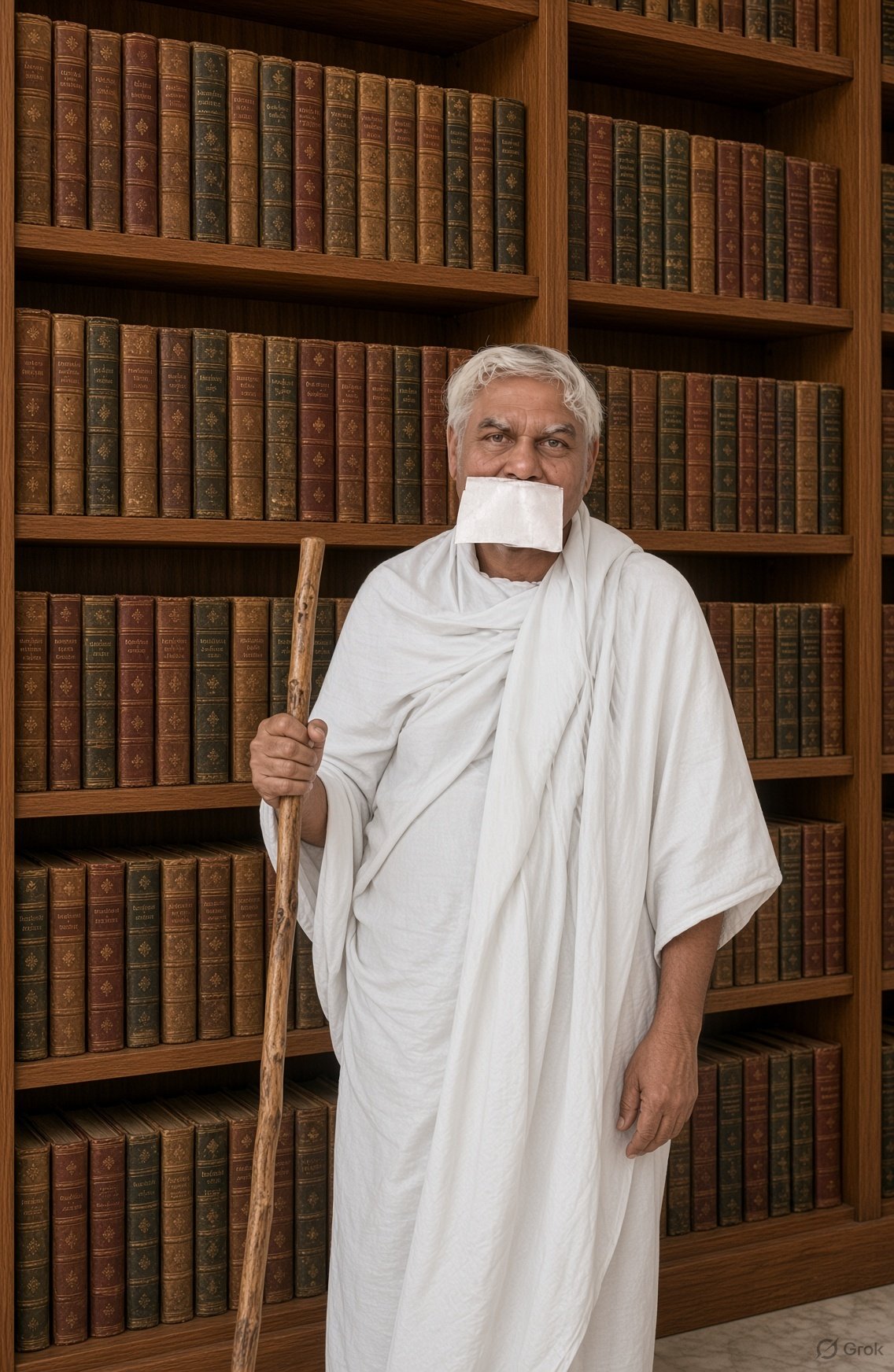
According to the biography recordShri Surendra Muniji Maharaj Saheb was born on 3 August 1973 in Madanganj, Ajmer, Rajasthan. His father's name was Shri Chand Malji Bamb, and his mother's name was Smt. Prem Bai. Another biographical record, published by HereNow4U, gives his pre-diksha name as Sanjay Jain (Bumb) and identifies his birthplace as Jamola village in Ajmer district.
The biography states that Surendra Muniji developed an interest in religion during his early years and spent several years in the company of Acharya Shri Anand Rishi Ji Maharaj. This association helped shape his inclination towards a life of religious discipline and spiritual study. In Jainism, the decision to renounce worldly life is traditionally associated with vairagya—a recognition of the impermanent nature of material possessions, social status and worldly pleasures. The path of a Jain monk involves dedicating one's life to spiritual development, the study of religious teachings, non-violence and self-restraint. Surendra Muniji's early attraction to religion ultimately led him to embrace this demanding way of life.
Shri Surendra Muniji accepted Jain monkhood on 29 November 1987, under the guidance of Acharya Shri Anand Rishi Ji Maharaj. At the time of initiation, he received the religious name Surendra Muni. The account also records that he was recognised as a disciple of Up-Pravartak Dr. Rajendra Muniji Maharaj Saheb of the Shvetambar Sthanakwasi Shraman Sangh. A separate biographical record places his initiation at Ahmednagar, Maharashtra, and records his religious teacher as Acharya Shri Anand Rishi Ji Maharaj. Diksha is a fundamental turning point in Jain religious life. It signifies the renunciation of ordinary worldly pursuits and the acceptance of ascetic discipline.
The principal ideals underlying this commitment include:
Ahimsa: Non-violence towards all living beings.
Satya: Truthfulness in speech and conduct.
Aparigraha: Freedom from possessiveness and material attachment.
Samyam: Control over desires and passions.
Swadhyaya: Continuous study and reflection on religious teachings.
His initiation marked the beginning of a life devoted to Jain philosophy, religious education, public preaching and service to society.
An important part of Surendra Muniji's spiritual lineage is his association with Up-Pravartak Dr. Rajendra Muniji Maharaj Saheb. The biography identifies Dr. Rajendra Muniji as the senior spiritual figure with whom Surendra Muniji was associated following his initiation. The guru-disciple relationship plays a central role in the Sthanakwasi Jain tradition. A guru provides spiritual guidance, encourages the study of Jain scriptures and helps a disciple develop the discipline required for monastic life. Surendra Muniji's later activities in religious education, literary writing and the organisation of Jain conferences reflect the importance of learning and public engagement in his spiritual journey.
Surendra Muniji is recorded as having studied several languages, including:
Hindi
Gujarati
Sanskrit
Prakrit
English
This linguistic background is particularly relevant to Jain scholarship. Prakrit is important for the study of traditional Jain scriptures. Sanskrit provides access to classical Indian philosophical and literary works. Hindi and Gujarati are important languages for communicating Jain teachings to broad audiences, while English can help introduce Jain ideas to readers beyond Hindi-speaking communities. A religious teacher who can work across several languages is better equipped to explain complex ideas, engage with different audiences and contribute to the wider circulation of religious literature.
The published biography describes Surendra Muniji as an articulate speaker, a thoughtful scholar and a religious preacher. It also records his efforts to organise conferences and seminars on Jain religion and philosophy, particularly to encourage younger generations to learn about Jain teachings.Religious discourses are an important means of transmitting Jain values. They can explain the principles of karma, non-violence, forgiveness, compassion and self-restraint in ways that relate to everyday life. For younger audiences, such programmes can provide opportunities to understand Jain philosophy beyond customary rituals and festivals. They can also encourage reflection on ethical questions involving family relationships, professional conduct, consumption and responsibility towards other living beings. Surendra Muniji's reported interest in conferences and seminars suggests an emphasis on taking religious learning beyond individual study and making it accessible through collective discussion.
One of the most distinctive aspects of Surendra Muniji's biography is his work as a writer. He has written stories, novels, poems, essays and children's literature, and has published books intended to benefit society. The biography lists the following works:
1. Maa, Mujhe Bhi Jeene Ka Hak Hai (Mother, I Too Have the Right to Live) Hindi • 2007 A title that raises the issue of the value of life and the right of living beings to exist. Its precise contents should be confirmed from the book itself.

2. Paraya Dhan (Others' Wealth) Hindi • 2006 A literary work whose title evokes questions of property, relationships and ethical conduct.

3. Maha Prabhu Mahavir Hindi • 2003 A work concerning Lord Mahavir, the 24th Tirthankara of Jainism, whose teachings form the foundation of Jain ethics and spiritual practice.
4. Kshama Shikha (Forgiveness at Its Peak) Hindi • 2002 The title highlights forgiveness, a virtue central to Jain spiritual practice and the observance of Kshamavani.
5. Path Ke Deep (Lamps of the Path ) Hindi • 2002 A title suggestive of guidance and illumination on the path of ethical and spiritual development.
6. Sabhyata Ke Shikhar Par (At the Summit of Civilisation) Hindi • 2002 A work whose title suggests reflection on civilisation, values and human development.
7. Dr. Rajendra Muni — Sadhana and Sarjana Hindi • 2002
A biographical work about Up-Pravartak Dr. Rajendra Muniji Maharaj Saheb, documenting the life and religious and literary activities of his spiritual mentor.

8. Uphar (Gift) Hindi • 2002
Another work listed in his published bibliographyhe titles and publication years above are transcribed from the JainSamaj.org biography. The displayed cover images are illustrative search results and have not been verified as the original editions. His writing across different genres indicates an interest in communicating religious and ethical ideas to a broad readership. Children's literature, in particular, can help introduce younger readers to compassion, honesty, respect for life and responsible behaviour.
Surendra Muniji undertook vihar through several Indian states, travelling from village to village to spread the teachings of Lord Mahavir. The regions listed include Gujarat, Haryana, Himachal Pradesh, Jammu, Madhya Pradesh, Maharashtra, Punjab, Rajasthan and Uttar Pradesh. Vihar is an important aspect of the traditional life of Jain monks. Rather than remaining permanently in one place, monks travel according to their religious discipline, often staying in a locality for a period of teaching and spiritual activity. These journeys allow monks to deliver discourses, guide devotees, encourage religious study and maintain connections between different Jain communities. The practice also embodies simplicity and detachment. Walking from place to place requires discipline and reflects the traditional emphasis on limiting possessions and avoiding unnecessary dependence on material comforts.
A particularly important aspect of Surendra Muniji's recorded work is his interest in organising seminars and conferences on Jain religion and philosophy for young people. The transmission of religious values to younger generations is essential to the continuity of any religious tradition. Young people often face questions concerning career choices, competition, relationships, consumption and personal responsibility. Jain philosophy offers a framework for addressing these questions through non-violence, honesty, moderation, respect for different perspectives and self-restraint. Conferences and educational programmes can help young people explore these principles in a setting that encourages learning and discussion. Such activities also help ensure that Jain heritage remains a living intellectual and ethical tradition rather than merely a historical inheritance.
The Sthanakwasi tradition is one of the principal traditions within Shvetambar Jainism. It places particular emphasis on the teachings of the Jain scriptures, meditation, ascetic discipline and worship without the use of temple idols. Surendra Muniji's recorded activities—as a monk, writer, religious speaker and organiser of educational events—are relevant to the continuation of this tradition. His literary work preserves religious and ethical themes in written form, while his discourses and journeys provide opportunities for direct engagement with devotees. These two forms of activity complement each other: books can preserve knowledge across generations, while personal teaching enables questions, discussion and the practical application of religious principles.
The life and work associated with Surendra Muniji can be understood through several fundamental Jain principles.
Ahimsa — non-violence: Respect for every living being and the avoidance of unnecessary harm.
Satya — truthfulness: Speaking honestly and acting with integrity.
Aparigraha — non-possessiveness: Reducing attachment to wealth, possessions and status.
Kshama — forgiveness: Letting go of resentment and cultivating peaceful relationships.
Swadhyaya — self-study: Continuously studying and reflecting on religious teachings.
Anekantavada — many-sided understanding: Recognising that complex questions may need to be considered from different perspectives.
These principles are particularly relevant to a monk whose published work includes a book on Lord Mahavir and another whose title explicitly concerns forgiveness.
Sahitya Divakar Shri Surendra Muniji Maharaj Saheb, as referred to in your request, represents the literary, educational and ascetic dimensions of the Shvetambar Sthanakwasi Jain tradition. His biography records an early inclination towards religion, initiation into monkhood in 1987, the study of several languages, extensive travel to spread Jain teachings, and the writing of books, essays, poetry and children's literature. His reported efforts to organise conferences and seminars also reflect an interest in making Jain philosophy accessible to younger generations. His literary contribution is especially meaningful because the written word can carry religious teachings beyond geographical boundaries and preserve them for future generations. The enduring message of Jain ascetic life is that knowledge must be accompanied by humility, devotion by self-discipline, and religious learning by compassion towards all living beings. May the teachings of Lord Mahavir continue to inspire humanity towards Ahimsa, forgiveness, truthfulness, self-restraint and universal peace.

R26102026
Ahimsa Foundation warmly welcomes information, photographs, literature, articles, and other meaningful contributions for publication on this web portal: www.jainsamaj.org | ✉ CAINDIA@HOTMAIL.COM
We also invite advertisements and sponsorship support to help us expand the reach of this social initiative and promote public awareness of Jain ideology.

Copyright © 2026 jainsamaj. All rights reserved.