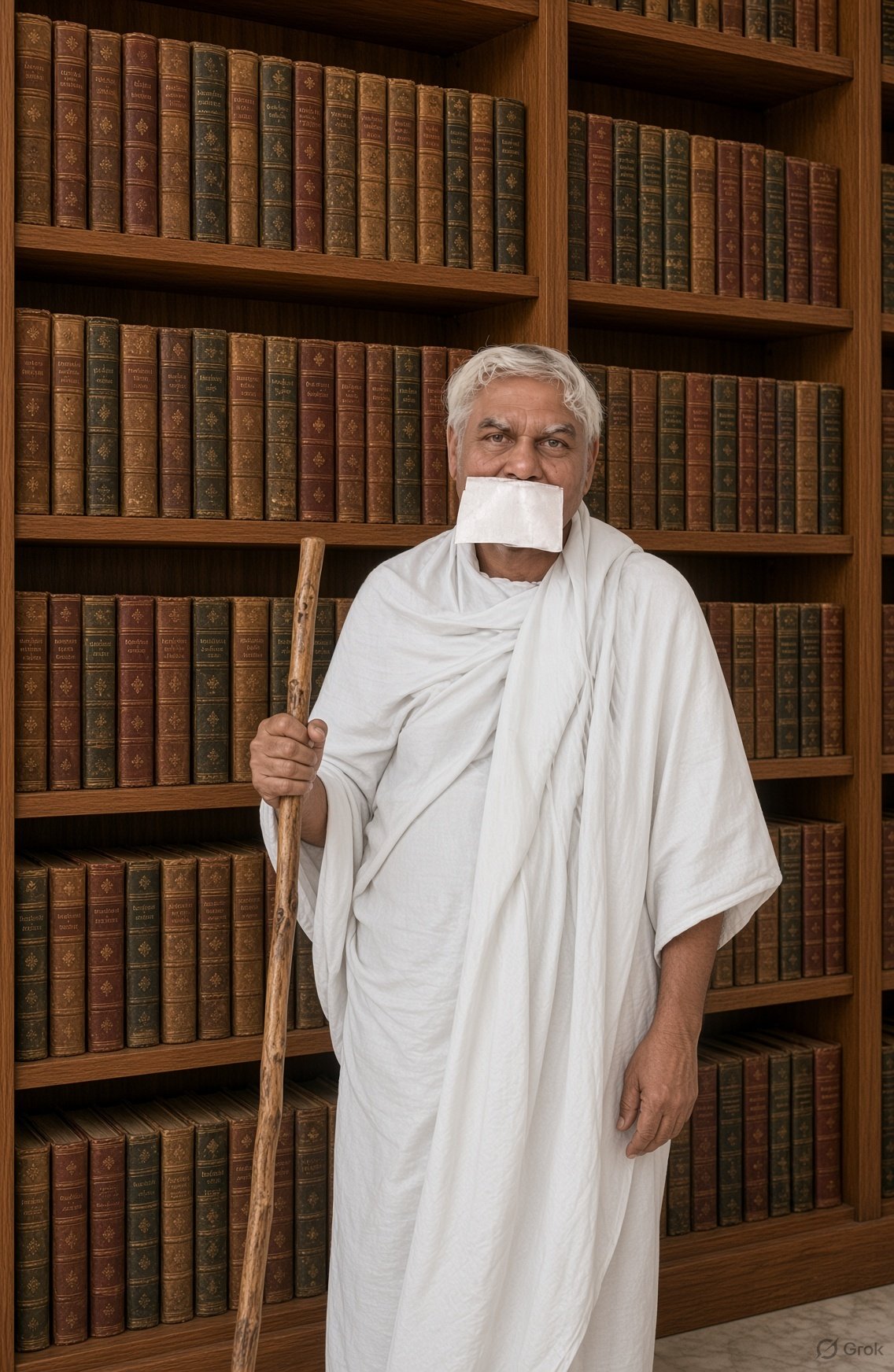
Acharya Shri Abhay Sagar Surishwarji Maharaj Saheb is remembered in the Jain religious tradition as a revered spiritual master associated with scriptural learning, rigorous ascetic discipline, meditation, and the propagation of Jain teachings. His name is particularly associated with the spiritual lineage that inspired important Jain pilgrimage centres and the religious development of his disciples.
According to the biographical account, Gurudev Shri Abhay Sagarji Maharaj Saheb accepted Jain initiation, or diksha, at the remarkably young age of six and a half years. Diksha in Jainism represents a profound commitment to renunciation, self-discipline, and the pursuit of liberation from the cycle of birth and death. By embracing this path in early childhood, Gurudev's life became an example of dedication to spiritual practice rather than the pursuit of worldly comforts. The Jain ascetic tradition places great importance on controlling desires, practising non-violence, speaking truthfully, limiting possessions, and cultivating equanimity. These principles provide the framework for understanding the significance of his religious life.
One of the most notable aspects of Gurudev Shri Abhay Sagarji's life was his reputation for scriptural knowledge and philosophical understanding. He attained advanced qualifications in grammar, literature and jurisprudence by the age of thirteen. It also states that, by the age of eighteen, he was delivering religious discourses before audiences numbering in the thousands. The account describes him as a scholar and reciter of 45 Jain Agamas. These details illustrate the importance of knowledge in the Jain spiritual tradition. Jainism does not regard religious life as merely a matter of ritual observance. It also emphasises Samyak Darshan (right faith), Samyak Jnana (right knowledge) and Samyak Charitra (right conduct). A spiritual teacher who combines scriptural study with disciplined conduct can help devotees understand the deeper meaning of religion and apply its teachings in everyday life. Gurudev's association with the study of Jain Agamas is particularly significant because these scriptures preserve teachings concerning the soul, karma, ethical conduct, non-violence, renunciation and spiritual liberation.
Gurudev Shri Abhay Sagarji was a great yogi, a scholar of the Agamas, and an accomplished practitioner of the Namaskar Mahamantra. In Jain philosophy, spiritual progress requires more than intellectual understanding. Knowledge must be supported by self-restraint, meditation, austerity and freedom from attachment. The disciplined life of a Jain monk is built around the effort to minimise harm to living beings and reduce the passions that bind the soul to karma. Meditation and mantra recitation can serve as means of cultivating concentration, humility, peace and spiritual awareness. The Namokar, or Navkar, Mantra occupies a central position in Jain devotional practice. It expresses reverence for spiritually elevated beings and reminds practitioners of the qualities they should strive to develop. Gurudev's association with Navkar Sadhana reflects the importance of this practice in his spiritual legacy.
An important aspect of Gurudev's legacy is his association with the revival and development of Jain sacred places. He is generally identified s an inspiration behind the revival of Jambudweep Mandir at Palitana and Nageshwar Tirth. It also connects his spiritual vision with the conception of a magnificent image of Lord Adinath, the first Jain Tirthankara. The same account explains that his disciple Acharya Shri Ashok Sagar Surishwarji and the two revered monk brothers, Acharya Shri Jinchandrasagar Surishwarji and Acharya Shri Hemchandrasagar Surishwarji, were associated with the subsequent development of important religious initiatives.
5. The importance of his disciples and spiritual lineage
In Jainism, the relationship between a guru and a disciple is central to the preservation and transmission of religious teachings.
Gurudev Shri Abhay Sagarji's spiritual lineage is particularly relevant to understanding the history of Ayodhyapuram Tirth. According to the institution's account, Acharya Shri Ashok Sagar Surishwarji Maharaj Saheb was one of the important spiritual figures in this lineage. The two monk brothers popularly known as Bandhu Beladi—Acharya Shri Jinchandrasagar Surishwarji and Acharya Shri Hemchandrasagar Surishwarji—are described as disciples within this broader lineage and as the principal inspirations behind Ayodhyapuram Tirth. Their work illustrates how spiritual inspiration can be transformed into lasting institutions that serve devotees, preserve religious traditions and provide places for worship and contemplation. The legacy of a guru is therefore not measured only by personal austerity or scholarship. It can also be seen in the values, commitments and religious activities carried forward by disciples.
The life and teachings associated with Gurudev Shri Abhay Sagarji can be appreciated through several enduring Jain principles.
Ahimsa — non-violence: Respect for all living beings and the avoidance of unnecessary harm.
Aparigraha — non-possessiveness: Freedom from excessive attachment to wealth, possessions and worldly status.
Samyam — self-restraint: Discipline over one's thoughts, speech, desires and conduct.
Swadhyaya — scriptural study: The continuous effort to understand religious teachings and apply them to life.
Samata — equanimity: Remaining balanced in success and failure, praise and criticism, pleasure and pain.
Seva — service: Supporting the preservation of religious knowledge, pilgrimage centres and the welfare of the community.
These principles are relevant not only to monks and nuns but also to householders, professionals, businesspeople and young people. A society that values non-violence, honesty, moderation and compassion can create a stronger ethical foundation for peaceful coexistence.
The significance of Gurudev Shri Abhay Sagarji Maharaj Saheb lies in the combination of early renunciation, scriptural scholarship, spiritual discipline and inspiration for religious institutions that is described in the Jain tradition. His association with the development of pilgrimage centres and the spiritual lineage of later Jain Acharyas gives his life a significance extending beyond individual religious practice. His influence is remembered through the work of disciples and the continued development of places dedicated to Jain worship and spiritual reflection. For devotees, the most meaningful way to honour a revered Acharya is to reflect on the principles he represents and bring those principles into daily conduct. Respect for life, restraint in consumption, compassion towards others and a commitment to truth remain central to the Jain spiritual path.
Pujya Acharya Shri Abhay Sagar Surishwarji Maharaj Saheb occupies a respected place in the spiritual tradition associated with Jain scriptural learning, ascetic practice and the inspiration of religious pilgrimage centres. His early diksha, advanced scriptural learning and association with Navkar Sadhana are among the principal features highlighted in the available institutional biography. His legacy also reminds us that the influence of a spiritual teacher can continue long after his immediate presence through the dedication of disciples, the preservation of sacred knowledge and the institutions inspired by his vision. May the teachings and spiritual ideals associated with Pujya Gurudev Shri Abhay Sagarji Maharaj Saheb continue to inspire the Jain community to follow the path of Ahimsa, restraint, knowledge and spiritual progress.

R26102026
Ahimsa Foundation warmly welcomes information, photographs, literature, articles, and other meaningful contributions for publication on this web portal: www.jainsamaj.org | ✉ CAINDIA@HOTMAIL.COM
We also invite advertisements and sponsorship support to help us expand the reach of this social initiative and promote public awareness of Jain ideology.

Copyright © 2026 jainsamaj. All rights reserved.