


From War to Wisdom: Lessons the World Must Learn

By: Anil K. Jain, FCA, President–Ahimsa Foundation India
& Sr. Macroeconomist (Mail: caindia@hotmail.com)
A Conflict
That Affected the Entire World
The recently concluded
America–Iran–Israel conflict was not merely a regional military confrontation.
It became a global event with implications for international diplomacy, energy
security, economic stability, military strategy, and humanitarian concerns. In today's
interconnected world, a conflict in one region can affect stock markets in
another, increase fuel prices across continents, disrupt global supply chains,
and create uncertainty for governments and businesses worldwide.
This conflict serves as a powerful
reminder that modern warfare is no longer confined to national borders. It
affects the entire international community. Therefore, policymakers, military leaders, international organisations, and ordinary citizens need to understand the lessons emerging from this conflict and identify
practical measures to prevent similar crises in the future.
There Are No
Real Winners in Modern Warfare
One of the most important
lessons from the conflict is that there are rarely any true winners in modern
wars. While one side may achieve certain military objectives, all parties
generally suffer significant losses. Military operations destroy
infrastructure, reduce economic activity, disrupt trade, increase government
expenditure, and create long-term political instability. Even when military
victories are achieved, they often come at enormous financial and human costs.
The United States spent
trillions of dollars during the wars in Iraq and Afghanistan. Despite major
military successes, those conflicts continued for years and left behind
significant political, economic, and social challenges. Similarly, the recent
America–Iran–Israel confrontation demonstrated that military power alone cannot
guarantee lasting peace. The lesson is simple: military victory does not
necessarily translate into political stability or long-term security.
Escalation
Can Become Extremely Dangerous
Modern conflicts possess the
potential to escalate very rapidly. A single missile strike, drone attack, or
military miscalculation can trigger a chain reaction of retaliation and
counter-retaliation. History provides many examples. The assassination of
Archduke Franz Ferdinand in 1914 triggered a series of events that eventually
led to the First World War, causing millions of deaths.
The recent conflict
demonstrated similar risks. At various stages, there were concerns that
additional regional powers, proxy groups, or international allies might become
involved. Had this occurred, the conflict could have expanded significantly
beyond its original scope. Governments must therefore recognise that preventing
escalation is often more important than achieving short-term military gains.
Diplomacy
Remains Humanity's Strongest Weapon
Military force can destroy
targets, but only diplomacy can create lasting peace. The Cuban Missile Crisis
of 1962 remains one of the best examples of successful diplomacy. The United
States and the Soviet Union came dangerously close to nuclear war. Ultimately,
diplomatic negotiations prevented what could have become one of the greatest
disasters in human history. Similarly, even during the recent conflict,
diplomatic efforts, mediation initiatives, and behind-the-scenes communication
played an important role in reducing tensions.
Future conflicts must always
include open communication channels, emergency diplomatic contacts, and trusted
mediators. Dialogue should continue even between adversaries. When diplomacy
stops, misunderstandings increase. When misunderstandings increase, conflict
becomes more likely.
International
Institutions Must Become More Effective
The conflict also highlighted
limitations in the current international security system. Organisations such as
the United Nations were established to maintain international peace and
security. However, many modern conflicts reveal that international institutions
often react after violence has already occurred rather than preventing it
beforehand.
The world witnessed similar
challenges during conflicts in Syria, Ukraine, Gaza, Yemen, Sudan, and several
other regions. There is an urgent need to strengthen international mechanisms
for conflict prevention, early warning systems, peace mediation, humanitarian
assistance, and ceasefire monitoring. Preventing wars is always less costly
than managing their consequences.
Economic
Consequences Extend Far Beyond the Battlefield
Wars do not affect only the
countries directly involved. They often have global economic consequences. The
Middle East remains one of the world's most important energy-producing regions.
Any instability in the region can influence oil prices, shipping costs,
insurance premiums, and international trade. The Strait of Hormuz, located near
Iran, is one of the world's most critical maritime chokepoints. Approximately
one-fifth of global oil consumption passes through this region.
Whenever tensions increase,
energy-importing countries such as India, Japan, South Korea, and many European
nations become concerned about supply disruptions and rising prices. The
conflict demonstrated how geopolitical instability can quickly affect
inflation, transportation costs, and economic growth worldwide.
Technology Has Changed the
Nature of Warfare
Modern warfare looks very
different from wars fought in previous centuries. The recent conflict
highlighted the growing importance of drones, cyber warfare, satellite
surveillance, precision-guided missiles, artificial intelligence, and
electronic warfare systems. The Russia–Ukraine conflict has already
demonstrated how relatively inexpensive drones can damage expensive military
equipment worth millions of dollars.
Similarly, cyberattacks can
disrupt financial institutions, communication systems, power grids, airports,
hospitals, and government services without a single soldier crossing a border. Future
national security strategies must therefore focus not only on tanks and
aircraft but also on cybersecurity, data protection, artificial intelligence,
and critical infrastructure resilience.
Nuclear
Risks Continue to Threaten Humanity
Although
nuclear weapons were not used during this conflict, the possibility of
escalation involving nuclear-capable states remains a serious concern. The
world has already experienced moments when nuclear war appeared possible. The
Cuban Missile Crisis is one example. Several India–Pakistan confrontations have
also raised international concern about the risk of escalation. Experts widely
agree that there can be no meaningful winner in a nuclear conflict. The
environmental consequences, humanitarian devastation, economic collapse, and
long-term health impacts would affect not only the countries directly involved
but potentially the entire planet. This is why global efforts toward arms
control, nuclear safeguards, and strategic dialogue remain critically
important.
Civilians
Pay the Highest Price
Perhaps the most tragic lesson
from any conflict is that ordinary citizens often suffer more than military
forces. When wars occur, civilians face displacement, loss of livelihood,
destruction of homes, interruption of education, shortages of essential goods,
and psychological trauma. According to
recent international estimates, more than 117 million people worldwide have
been forcibly displaced due to conflict, violence, and persecution. Behind
every military statistic are real families, real children, and real communities
whose lives are permanently changed. The protection of civilians must therefore
remain a central objective in every conflict-management strategy.
Responsible
Leadership Is More Important Than Ever
Political and religious
leaders play a crucial role during periods of tension. History shows that
irresponsible rhetoric can inflame emotions, deepen divisions, and increase the
likelihood of violence. Conversely, responsible leadership can calm public
opinion, encourage dialogue, and promote peaceful solutions. During periods of
conflict, leaders must exercise restraint in their public statements and avoid
language that encourages hatred or demonises entire populations. Religious
leaders, community leaders, and civil society organisations should work
together to promote understanding, tolerance, and peaceful coexistence. Leadership
is ultimately tested not in peace but in a crisis.
The World
Must Invest More in Peace Than in War
Global military expenditure
exceeds two trillion dollars annually. While national security remains
essential, it is worth considering what humanity could achieve if even a small
percentage of military spending were redirected toward education, healthcare,
water security, environmental protection, scientific research, poverty
reduction, and infrastructure development.
Many conflicts emerge from
economic inequality, resource scarcity, unemployment, political instability,
and social frustration. Investing in human development is therefore one of the
most effective long-term strategies for promoting peace. A world that invests
in opportunity is less likely to invest in conflict.
WHAT SHOULD BE DONE IF A SIMILAR CRISIS OCCURS AGAIN?
Establish
Immediate Crisis-Management Mechanisms
When tensions begin to rise,
governments and international organisations should activate emergency
communication systems immediately. Military hotlines should be operational 24
hours a day. Neutral mediators should be appointed quickly. Diplomatic missions
should remain active even during periods of hostility. Rapid communication can
prevent misunderstandings that might otherwise lead to unnecessary escalation.
Implement
Emergency Ceasefire Frameworks
The international community
should develop standardised ceasefire mechanisms that can be activated rapidly.
Independent observers, peacekeeping personnel, and humanitarian agencies should
be prepared to intervene immediately after hostilities begin. The objective
should be to stop violence before it expands.
Protect
Civilian Populations
Humanitarian corridors should
be established quickly to allow the movement of medical supplies, food, water,
and emergency relief. Hospitals, schools, religious institutions, and civilian
infrastructure should receive special protection under international law. Protecting
innocent lives must remain a priority regardless of political differences.
Strengthen
Regional Security Dialogues
Long-term peace requires
continuous communication. Regional forums should be established where rival
nations can discuss concerns, share information, address misunderstandings, and
build confidence. Regular dialogue reduces the likelihood of crises.
Reform
Global Governance Structures
The world has changed
dramatically since the United Nations was established in 1945. Many experts
believe that global institutions should be reformed to reflect current geopolitical realities better.
Emerging powers such as India
and several other developing nations should play a greater role in
international decision-making processes. A stronger and more representative
international system could improve conflict prevention and crisis management.
India's Role and Responsibility
A Potential
Bridge Between Competing Powers
India occupies a unique
position in international diplomacy. India maintains productive relations with
the United States, Israel, Iran, Gulf nations, Russia, Europe, and many
developing countries.
This balanced approach enables
India to act as a credible voice for dialogue, stability, and peaceful conflict
resolution. India should continue strengthening its energy security, strategic
autonomy, diplomatic engagement, and defence preparedness while promoting peace
and international cooperation.
Conclusion
The Greatest
Lesson for Humanity
The America–Iran–Israel
conflict should be viewed as a warning rather than merely a historical event. It
reminds us that military power alone cannot guarantee security. Lasting peace
requires diplomacy, responsible leadership, strong institutions, economic
cooperation, humanitarian values, and mutual respect among nations.
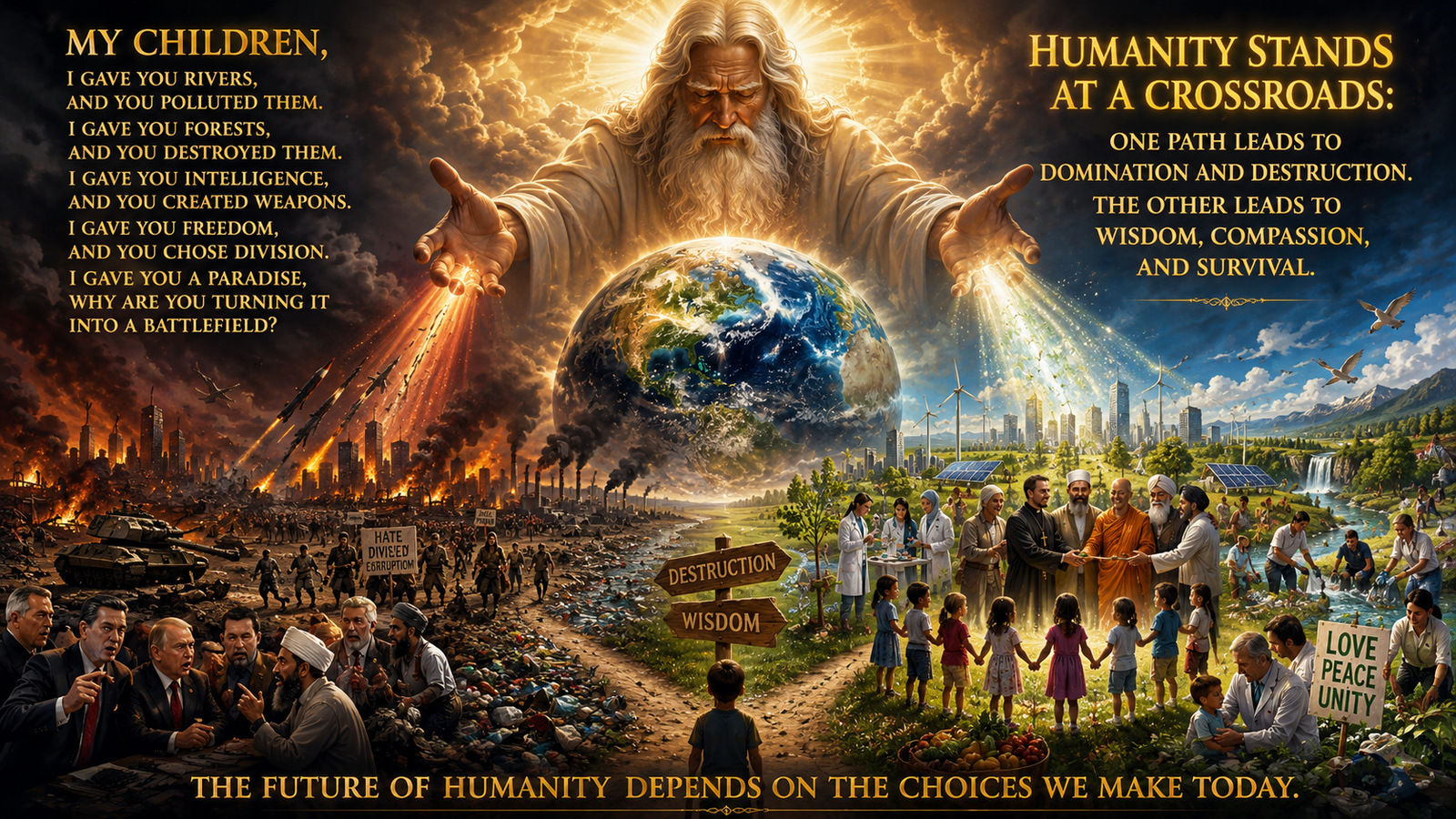
The ultimate lesson is that humanity's future cannot be built upon endless cycles of confrontation and retaliation. The real measure of civilization is not how effectively nations wage war, but how effectively they prevent it. The future of humanity will depend not on who possesses the most powerful weapons, but on who demonstrates the greatest wisdom, restraint, and commitment to peace.

Mail to : Ahimsa Foundation
www.jainsamaj.org
R250326
Ahimsa Foundation warmly welcomes information, photographs, literature, articles, and other meaningful contributions for publication on this web portal: www.jainsamaj.org | ✉ CAINDIA@HOTMAIL.COM
We also invite advertisements and sponsorship support to help us expand the reach of this social initiative and promote public awareness of Jain ideology.
 Related
 Related
 Related

Copyright © 2026 jainsamaj. All rights reserved.